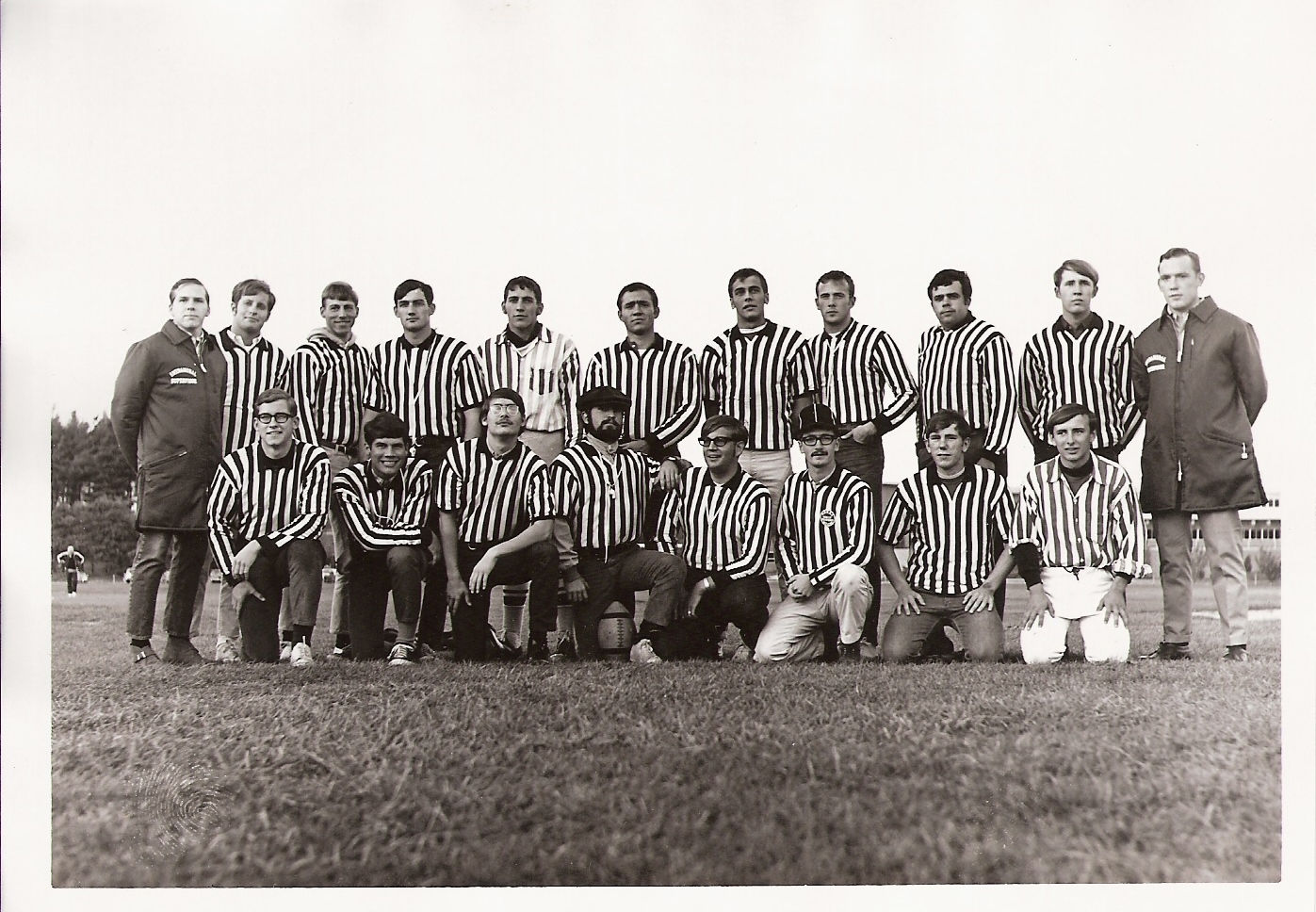
Each intramural activity is administered in accordance with rules set by a national governing body. Those standards are sometimes modified to fit within the scope of the intramural sports program. Below, you will find the modifications specific to each intramural activity offered at MSU.
The most important set of rules is the Participant Handbook. The handbook outlines the standards and expectations for all intramural activities at MSU. This is mandatory reading for all intramural participants.
Basketball
5v5 Basketball
NFHS Rules govern play with the following modifications.
STARTING THE GAME
Each team must have at least 4 players present, ready to play, at the designated game time. If the required number of players is not present, the Forfeit Procedure outlined in the Participant Handbook will be followed.
PLAYING PERIOD
The game will consist of four quarters of nine minutes each. The clock will run continuously except as noted below.
There will be a one-minute break between quarters and a three-minute break between halves.
The clock will not stop for a foul, held ball, or violation until there are less than two minutes remaining in the second half or less than one minute remaining in an overtime period.
The clock will stop for injuries and official timeouts.
TIME OUTS
Each team will receive one 30-second timeout per half.
Timeouts do not carry over from one half to the next.
FOULS
Team and individual foul totals will be recorded.
An individual player will be disqualified after committing their fifth foul.
A player will be ejected after receiving two technical fouls, one flagrant foul, or one flagrant technical foul.
Free throws will be awarded for shooting fouls and after the fourth team foul of a quarter.
Beginning with the fifth team foul of the quarter, the offended team will receive two bonus free throws.
Team foul totals will reset at the beginning of each quarter, except that fourth-quarter foul totals will carry into overtime.
Technical, Intentional, and Flagrant fouls will result in an automatic two points being awarded. No free throws will be attempted for these fouls.
OVERTIME
If the score is tied at the end of regulation, one three-minute overtime period will be played.
The first two minutes of overtime will use a running clock. The final minute will use stopped time.
There will be a one-minute intermission before overtime.
Overtime will begin with a jump ball.
Team and individual fouls from the fourth quarter will carry into overtime.
Each team will receive one timeout during overtime. Timeouts from regulation do not carry over.
If a regular-season game remains tied following the overtime period, the game will remain a tie.
During playoffs, additional overtime periods will be played until a winner is determined.
SUBSTITUTIONS
Substitutes must report to the scorer's table and may enter the game only after being beckoned onto the court by an official.
Players may re-enter the game an unlimited number of times unless they have been disqualified or ejected.
Failure to wait for an official to beckon a substitute onto the court will result in a warning. Additional violations may result in a technical foul.
EQUIPMENT
Closed-toed, non-marking gym shoes must be worn.
Hats, bandanas, jeans, and jewelry are prohibited.
The HOME team will wear white numbered jerseys. The AWAY team will wear green numbered jerseys.
Teams may wear their own jerseys provided the jersey color corresponds with the team's designated home or away color and each player has a unique number.
Participants using a jersey checked out from Recreational Sports and Fitness Services must wear a full T-shirt underneath the jersey.
MERCY RULE
The game will end if a team obtains a 50-point lead at any time.
The game will also end if a team obtains a 30-point lead with fewer than five minutes remaining.
PLAYER, COACH, SPECTATOR CONDUCT
Harassing language or behaviors related to race, age, sexual orientation, ethnic origin, handicapping condition, political persuasion, or other protected characteristics are unacceptable.
Intramural staff may penalize, disqualify, or eject participants when necessary.
Participants should refer to the Participant Handbook for additional conduct expectations and disciplinary procedures.
PLAYOFFS
A team will not be eligible for playoffs if it accumulates more than two ejections during the regular season.
Any player ejected during the playoffs will be ineligible for the remainder of the playoffs.
A team will not be eligible for playoffs if it accumulates more than one forfeit during the regular season.
CO-REC MODIFICATIONS
A five-player team will consist of three women and two men.
A four-player team will consist of two women and two men.
There are no additional restrictions or point modifications for Co-Rec Basketball.
3v3 Basketball
NFHS Basketball Rules govern play with the following modifications.
RULE 1. THE GAME
Section 1. The game shall be played between two teams of three players each.
Article 1. Three players must be ready to play at the beginning of the game.
Section 2. The game will be played once half of one regulation basketball court.
Section 3. Rock-paper-scissors will determine which team receives possession to begin the game.
Section 4. The game will be played until one team reaches 30 successful field goals or until 30 minutes have elapsed.
Article 1. Field goals are not calculated using traditional point values. A basket made from inside the three-point line and a basket made from outside the three-point line each count as one successful field goal.
Article 2. Half-time will occur when one team makes its 15th successful field goal.
Article 3. The second half will begin with the trailing team putting the ball into play.
RULE 2. PUTTING BALL IN PLAY
The ball will be put into play at the check-line located at the top of the free throw circle, approximately three feet outside the three-point arc.
The offensive player must pass the ball to a teammate after receiving the ball at the check-line. The player receiving the check may not immediately drive toward the basket.
Following a successful field goal, the opposing team will put the ball into play from the check-line.
Following a foul, the offended team will put the ball into play from the check-line.
RULE 3. FOULS
The player who commits a foul is responsible for calling the foul.
If the player committing the foul refuses to call it, the offended player may call the foul.
The penalty for a foul is possession of the ball by the offended team at the check-line.
Exception: A player fouled while shooting will not retain possession if the field goal is successful.
If players disagree about a foul call, the team in possession will shoot a do-or-die shot from the top of the free throw circle.
RULE 4. VIOLATIONS
The player committing a violation is responsible for calling the violation.
If a play who commits a violation refuses to call it, the opposing team may call the violation.
The penalty for a violation is possession of the ball by the opposing team at the check-line.
If players disagree about a violation call, the team in possession will shoot a do-or-die shot from the top of the free throw circle.
RULE 5. HELD BALL
A held ball occurs when players from opposing teams have simultaneous control of the ball and neither player can gain possession without undue roughness.
Following a held ball, possession will be awarded to the defensive team at the check-line.
RULE 6. TIME OUTS
Each team is permitted one timeout per half.
Each timeout will last one minute.
Timeouts do not carry over from one half to the next.
Flag Football
RULE 1. THE GAME, FIELD, PLAYERS, AND EQUIPMENT
Section 1. General Provisions
Article 1. Object of the Game.
It is the object of the game for 1 team to carry or pass the ball across the opponent’s goal line. The game is won by the team that accumulates the most points.
Article 2. The Game.
The game shall be played between 2 teams of 7 players each. Four players are required to start the game and avoid a forfeit. The game may be continued with fewer than 4 players as long as the team has a chance to win. NOTE: If in doubt, continue the game.
Article 3. The Co-Rec Game.
The co-rec game shall be played between 2 teams of 8 players, 4 men and 4 women. Teams with 7 players shall be 4 men and 3 women or 4 women and 3 men. Teams with 6 players shall be 3 men and 3 women, 4 men and 2 women, or 4 women and 2 men. Teams with 5 players, 3 men and 2 women or 2 men and 3 women, are required to start the game and avoid a forfeit. The game may be continued with fewer than 5 players as long as the team has a chance to win. NOTE: If in doubt, continue the game.
NOTE: Member institutions are encouraged to adopt and use the NIRSA Transgender Athlete Participation Policy for their events (see play.nirsa.net/nirsa-championship-series/player-eligibility-requirements). This policy is mandatory for NIRSA Championship Series events.
Article 4. Supervision.
The game shall be played under the supervision of 2 to 4 officials. The officials are Referee, Back Judge, Line Judge, and Field Judge. It is recommended strongly that a minimum of 3 officials be used. Positions and responsibilities are found in the Officials’ Manual.
Article 5. Captains.
Each coach or player-coach shall designate to the Referee the captain(s). If more than 1 player is designated, a speaking captain must be selected to make all decisions.
Article 6. Persons Subject to the Rules.
Players, nonplayers, and spectators affiliated with the team are subject to the Rules of the game and shall be governed by decisions of officials assigned to the game.
Article 7. Referee’s Authority.
The Referee shall have authority to rule promptly, and in the spirit of good sporting behavior, on any situation not specifically covered in the Rules. The Referee’s decisions are final in all matters pertaining to the game.
Article 8. Officials’ Authority.
The officials shall assume authority for the contest 30 minutes prior to the scheduled game time, or as soon as they arrive. The officials’ jurisdiction extends through the Referee’s declaration of the end of the 4th period or overtime.
Section 2. The Field
Article 1. Safety Margin.
No hard and unyielding rigid fixtures (e.g., trees, poles, fences) shall be located within 5 yards of the sidelines or 10 yards of the end lines, unless covered with at least 1/2" of closed-cell, slow-recovery rubber or other material of the same minimum thickness and having similar physical properties. NOTE: If in doubt, consider the safety of all participants to be paramount to the game.
Article 2. Adjacent Fields.
When fields are located in close proximity, there shall be a minimum of 5 yards between “side by side” fields and 10 yards between “end on end” fields.
Article 3. Field Markings.
The width of the field shall be lined at 20 yard intervals from goal line to goal line. These zone markings may be changed according to field dimensions. All yard lines inside the boundaries shall stop 4" from each sideline. There shall be 2 hash marks. They shall run parallel with each sideline, located 15 yards “in” from each sideline. The 3 and 10 yard Try lines and the 30 yard lines shall be 2 yards wide and 4" thick. Both 14 yard lines shall be marked with an “X” and shall have a height of 1 yard and a line thickness of 4". White is the recommended color for all field markings.
Article 4. Facility Limitations.
In case of facility limitations, distances of field length and width can be modified. However, end zone length must always be 10 yards. If the field length is modified, shorten all 4 zones equally so they are the same length. NOTE: When zones are shortened, the 3 and 10 yard Try lines remain the same. The 14 yard lines must be located 6 yards from the nearest zone line. The 30 yard lines must each be located 10 yards from the 40 yard line.
Article 5. Goal Line.
The entire width of each goal line shall be a part of the end zone.
Article 6. Team Box.
On each side of the field a team box shall be designated for the players and nonplayers. This team box is located 2 yards off the sideline and between the 20 yard lines. When the playing area is modified, so shall be the team box. If teams cannot agree on a sideline, the Referee shall conduct a coin toss. Both team boxes may be located on the same sideline, provided each team box is marked between their respective 20 and 35 yard lines.
Article 7. End Zone Pylons.
Soft, flexible pylons shall be placed at the inside corner of each of the intersections of the sidelines with the goal lines and the end lines, and at the intersections of the end lines and hash marks extended. Soft, flexible pylons may be placed at the intersections of the goal lines and hash marks extended. When properly placed, the goal line pylon is out of bounds at the intersection of the sideline and the goal line extended.
Article 8. Line-to-Gain and Ball Spotters.
Two soft and pliable ball spotters shall be used. One, orange in color, shall mark A’s scrimmage line. The second, gold in color, shall mark B’s scrimmage line. The ball spotters shall always be 1 yard apart.
Article 9. Down Box.
A down box shall be used to indicate the number of the down and placed at the zone line-to-gain. It shall be positioned 2 yards out of bounds and operated under the jurisdiction of the Line Judge. During the Try, the down box shall display the point value (1, 2, or 3) declared by A and be placed at the goal line.
Section 3. Game Equipment
Article 1. The Ball.
Each team may provide their own ball. There are no requirements regarding ball pressure and markings. Games involving only men shall use the regular size ball. The regular, intermediate, youth, or junior size football shall be used for all other games. The Referee shall be the sole judge of any ball offered for play and may change the ball during play at his or her discretion. During the game, each team shall use a legal ball of its choice when in possession.
Article 2. Ball Spotters.
2 soft and pliable ball spotters shall be used. 1, orange in color, shall mark A’s scrimmage line. The 2nd, gold in color, shall mark B’s scrimmage line. The ball spotters shall always be 1 yard apart.
Article 3. Down Box.
A down box shall be used to indicate the number of the down and placed at the zone line-to-gain. It shall be positioned 2 yards out of bounds and operated under the jurisdiction of the Line Judge. During the Try, the down box shall display the point value (1, 2, or 3) declared by A and be placed at the goal line.
Section 4. Required Player Equipment
Article 1. Jersey.
Players of opposing teams shall wear contrasting colored jerseys, without pockets, numbered on the front or rear. Players of the same team shall wear the same color or similar colored jerseys with different numbers. The visiting team is responsible for avoidance of similarity of colors. Jerseys shall be either long enough so they remain tucked into the pants/shorts during the entire down or short enough so there is a minimum of 4" from the bottom of the jersey to the player’s waistline. The Referee shall use a fist to measure the distance between the waistline and the bottom of the jersey.
Article 2. Pants/Shorts.
Each player shall wear pants or shorts. They shall be a different color than the flags.
Article 3. Flag Belt.
Each player shall wear a one piece quick release belt, without any knots, at the waistline with 3 flags permanently attached, 1 flag on each side and 1 in the center of the back. The flags shall be a minimum of 2" wide and 14" long when measured from the edge of the belt. The flags should be of a contrasting color to the opponent’s flags. The belt must have a spring loaded clip. NOTE: If the flags are not located on each hip and the tailbone, then the player must change to an appropriate size belt that meets the Rule.
PLAY. A-1 breaks the huddle not wearing a flag belt or the jersey is untucked as the 25 second count is running: (a) The Referee informs A-1 of the problem and as A-1 secures a flag belt or tucks in the jersey the 25 second count expires; or (b) the Referee points out the problem to A-1, who refuses to acquire a flag belt or tuck in the jersey; or (c) the Referee does not see A-1 without a flag belt as the ball is snapped and A-1 advances 25 yards before tagged by B-4; or (d) the Referee observes that A-1 or B-1 was not wearing a flag belt during the down. RULING. In (a), penalize A for delay of game. In (b), (c), and (d), the offended team can take the result of the play or penalize the offending team 5 yards from the previous spot for not wearing required equipment.
Article 4. Shoes.
Each player shall wear athletic shoes. They must be made of a canvas, leather, or synthetic material which covers the foot attached to a firm sole of leather, rubber, or composition material which may have cleats or be cleatless. Cleats are limited to studs or projections which do not exceed 1/2" in length and are made with nonabrasive rubber or rubber-type synthetic material which does not chip or develop a cutting edge. Rubber cleats with a tipped metal material are legal. NOTE: The cleats may screw into the sole of the shoes as long as the screw is part of the cleat. Athletic shoes that include a visible or exposed metal screw are prohibited.
Section 5. Player Equipment – Optional
Article 1. Headwear.
Players may wear a knit or stocking cap. The cap must have no bill. Players may also wear a headband no wider than 2". Rubber or cloth elastic bands may be used to control hair.
Article 2. Gloves.
Players may wear gloves which must consist of a soft, pliable and nonabrasive material.
Article 3. Pads.
Players may wear soft, pliable pads on the leg, knee, and/or ankle.
Article 4. Mouth and Tooth Protector.
It is strongly recommended that a mouthpiece be worn by all players.
Section 6. Player Equipment – Illegal
A player wearing illegal equipment shall not be permitted to play. This applies to any equipment which, in the opinion of the Referee, is dangerous or confusing. Types of equipment or substances which shall always be declared illegal include:
- Headwear containing any hard, unyielding, stiff material, including billed hats, or items containing exposed knots.
- Jewelry of any kind.
- Any hard or unyielding substance worn on the hand, wrist, forearm, or elbow, regardless of how covered.
- Any equipment which, in the opinion of the Referee, would endanger or confuse players.
- Equipment which includes computers or any electronic or mechanical devices for communication.
- Exposed metal on clothes or person.
- Towels attached at the player’s waist.
- Flags or flag belts that do not meet Rule requirements.
- Pants or shorts with belt loops or pockets.
- Any slippery or sticky foreign substance on any equipment or exposed part of the body.
The Referee shall decide whether any equipment is legal. Any equipment deemed dangerous shall be removed before the player participates.
RULE 2. DEFINITIONS OF PLAYING TERMS
Section 1. Ball Status; Dead, Live, and Loose
Article 1. Dead Ball. A dead ball is a ball not in play. The ball is dead during the interval between downs.
Article 2. Live Ball. A live ball is a ball in play. A ball becomes live when the ball is legally snapped and a down is in progress.
Article 3. Loose Ball. A loose ball is a pass, fumble, or a kick. A loose ball that has not yet touched the ground is in flight. A grounded loose ball is one that has touched the ground. Any loose ball continues to be a loose ball until a player secures possession of it or until it becomes dead by Rule, whichever comes first.
Article 4. When the Ball Is Ready for Play. A dead ball is ready for play when the Referee sounds the whistle and signals ready for play (S1).
Section 2. Batting
Batting is intentionally slapping, striking, or redirecting the ball with the hand or arm.
Section 3. Catch, Interception, Simultaneous Catch, and Touching
Article 1. Catch. A catch is the act of establishing player possession of a live ball in flight. A catch of an opponent’s pass or fumble is an interception. A player who attempts a catch or an interception is a receiver.
Article 2. Catch or Interception. A catch or interception is completed when a player inbounds secures possession of a pass, kick, or fumble in flight prior to the ball touching the ground and maintains possession of the ball long enough to clearly establish possession.
Article 3. Simultaneous Catch or Recovery. A simultaneous catch or recovery is a catch or recovery in which there is joint possession of a live ball by opposing players who are inbounds.
Article 4. Touching. Touching refers to any contact with the ball. Touching by a player or official may be intentional or accidental.
Section 4. Clipping
Clipping is running or diving into the back, or throwing or dropping the body across the back of the leg or legs of an opponent, or pushing an opponent in the back.
Section 5. Down and Between Downs
Article 1. Down. A down is a unit of the game which starts with a legal snap and ends when the ball next becomes dead. Between downs is the interval during which the ball is dead.
Section 6. Encroachment
Encroachment is a term to indicate a player is illegally in the neutral zone. An entering substitute is not considered to be a player for encroachment restrictions until they are on their team’s side of the neutral zone.
Section 7. Fair Catch
A fair catch is a catch of a punt beyond K’s scrimmage line and between the goal lines by an R player who has signaled their intention by extending 1 arm above their head and waving it from side to side more than once.
Section 8. Fighting
Fighting is any attempt by a player or nonplayer to strike or engage an opponent in a combative manner unrelated to football. Such acts include, but are not limited to, attempts to strike an opponent(s) with the arm(s), hand(s), leg(s), or foot (feet), whether or not there is contact.
Section 9. Flag Belt Removal
Article 1. Flag Belt Removal. When the flag belt is clearly taken from the runner in possession of the ball, the ball is declared dead and the down shall end.
Article 2. Touching Runner. If a flag belt inadvertently falls off, a 1 hand tag between the shoulders and knees constitutes capture.
Section 10. Fumble
A fumble is a loss of player possession other than by handing, passing, or punting the ball.
Section 11. Goal Line
Each goal line is a vertical plane separating the end zone from the field of play. The plane of the goal line extends beyond the sideline.
Section 12. Handing the Ball
Handing the ball is transferring player possession from 1 teammate to another without throwing or kicking it.
Section 13. Huddle
A huddle is 2 or more offensive players grouped together after the ball is ready for play and before assuming scrimmage formation prior to the snap.
Section 14. Hurdling
Hurdling is an attempt by a player to jump with 1 or both feet or knees foremost over an opponent who is contacting the ground with no part of their body except 1 or both feet.
Section 15. Kicks
Article 1. Kick. A kick is intentionally striking the ball with the knee, lower leg, or foot.
Article 2. Kicker. The kicker is any player who legally punts. The kicker is a runner until they actually kick the ball.
Article 3. Legal and Illegal Kicks. A legal kick is a punt made according to the Rules. Any other kick is illegal and shall be treated as a fumble.
Article 4. Punt. A punt is made by a player who drops the ball and kicks it before it strikes the ground.
Section 16. Loss of a Down
Loss of a down means loss of the right to repeat the down.
Section 17. Muff
A muff is an unsuccessful attempt to catch or recover a loose ball when the player touches the ball but does not gain possession.
Section 18. Neutral Zone
The neutral zone is from the forward point of the football 1 yard to B’s scrimmage line and extended to each sideline. It is established when the ball is ready for play.
Section 19. Passer
The passer is the player who has thrown a legal forward pass. They remain the passer while the ball is in flight or until they move to participate in the play.
Section 20. Passing
Article 1. Passing. Passing the ball is throwing it. A pass continues to be a pass until it is caught, intercepted, or becomes dead.
Article 2. Forward and Backward Pass. A forward pass is a pass thrown with its initial direction toward the opponent’s end line. A backward pass is a pass thrown with its initial direction parallel with or toward the passer’s end line.
Section 21. Penalty
A penalty is a loss imposed by Rule upon a team that has committed a foul.
Section 22. Play
A play is the action that takes place during a down.
Section 23. Player Possession
A player is in possession when they are holding or controlling the ball.
Section 24. Possession
A ball in player possession is a live ball held or controlled by a player. A ball in team possession is a live ball which is in player possession or one which is loose following loss of such player possession.
Section 25. Removing the Flag Belt
Removing the flag belt is the intentional removal of a flag belt from the runner by an opponent.
Section 26. Screen Blocking
Screen blocking is legally obstructing an opponent without using any part of the body to initiate contact.
Section 27. Shift
A shift is the action of 1 or more offensive players who, after a huddle or after taking set positions, move to a new set position before the ensuing snap.
Section 28. Snap
A snap is the legal act of passing or handing the ball backward from its position on the ground.
Section 29. Spot
Article 1. Basic Spot. The basic spot is a point of reference for penalty enforcement.
Article 2. Enforcement Spot. The enforcement spot is the point from which a penalty is enforced.
Article 3. Dead Ball Spot. The dead ball spot is the spot under the foremost point of the ball when it becomes dead.
Article 4. Inbounds Spot. The inbounds spot is the intersection of the hash mark and the yard line through the dead ball spot or the spot where the ball left the field between the goal lines.
Article 5. Previous Spot. The previous spot is where the ball was last snapped.
Article 6. Spot of the Foul. The spot of the foul is where the foul occurs. If out of bounds between the goal lines, it shall be the intersection of the nearer hash mark and the yard line extended on which the foul occurs.
Section 30. Substitute
A substitute is a team member who may replace a player or fill a player vacancy.
Section 31. Team Designations
Article 1. Team A and B. Team A is the team which puts the ball in play. The opponent is Team B.
Article 2. Team K and R. Team K is the team in possession when the ball is punted. The opponent is Team R.
Article 3. Offense and Defense. The offense is the team in possession. The opponent is the defense.
Section 32. Team Member
A team member is a member of an organized team.
Section 33. Tripping
Tripping is the use of the lower leg or foot to obstruct an opponent below the knees.
Section 34. Yard Line
A yard line is any line and its vertical plane parallel to the end lines.
RULE 3. PERIODS, TIME FACTORS, SUBSTITUTIONS
Section 1. Start of Each Half
Article 1. Coin Toss. Three minutes before the start of the game the Referee shall toss a coin in the presence of the opposing captains after first designating which captain shall call the toss.
The captain winning the toss shall have the first choice of options for the first half or shall defer their option to the second half. The options for each half shall be:
- To choose whether their team will start on offense or defense.
- To choose the goal their team will defend.
The captain not having the first choice of options for a half shall exercise the remaining option.
Article 2. Change Goals. Teams shall change goals after the first and third periods.
Section 2. Game Time
Article 1. Playing Time and Intermissions. Playing time shall be 40 minutes, divided into 4 periods of 10 minutes each. The intermission between the first and second and the third and fourth periods shall be 1 minute. The halftime intermission shall be 3 minutes.
Article 2. Shortened Periods. Before the start of the game, playing time may be shortened by mutual agreement of the opposing captains and the Referee.
Section 3. Extension of Periods
A period must be extended by an untimed down if during the last timed down of the period one of the following occurred:
- There was a foul, other than unsporting or nonplayer, by either team and the penalty is accepted.
- There was a double foul.
- There was an inadvertent whistle and the down is to be replayed.
- A touchdown was scored. The period is extended for the Try, except when the touchdown is scored during the last down of the fourth period and the point(s) would not affect the outcome of the game.
If any of the above occurs during the untimed down, the period will be extended by another untimed down.
Section 4. Game Timing
Article 1. First 38 Minutes. During the first 38 minutes of the game, the clock will run continuously except for a team timeout or an official’s timeout.
Article 2. Last 2 Minutes. Approximately 2 minutes before the end of the second half, the Referee shall stop the clock and inform both captains of the playing time remaining. The clock starts on the snap after the 2-minute warning.
During the final 2 minutes of the second half, the clock will stop for:
- Incomplete legal or illegal forward pass — starts on the snap.
- Out of bounds — starts on the snap.
- Safety — starts on the snap.
- Team timeout — starts on the snap.
- First down — dependent on the previous play.
- Touchdown — starts on the snap.
- Penalty and administration — dependent on the previous play.
- Referee’s timeout — starts at their discretion.
- Touchback — starts on the snap.
- Team B is awarded a new series — starts on the snap.
- Either team is awarded a new series following a legal punt — starts on the snap.
- Inadvertent whistle — starts on the ready or snap depending on the previous play.
Section 5. Mercy Rule
If a team is 19 or more points ahead when the Referee announces the 2-minute warning for the second half, the game shall be over.
If a team scores during the final 2 minutes of the second half and that score creates a point differential of 19 or more points, the game shall end at that point.
Section 6. Tie Game
Article 1. Regular Season. If the score is tied at the end of regulation during regular-season play, the game may end in a tie unless otherwise specified by the Intramural Sports Program.
Article 2. Playoffs. During playoff competition, an overtime procedure will be used to determine a winner.
Article 3. Overtime Coin Toss. A coin toss will determine the options. The winner of the toss shall choose offense, defense, or the end of the field at which both teams will play. The loser of the toss shall exercise the remaining option.
Article 4. Overtime Series. Each team will receive a series of downs from the designated overtime line. Teams will alternate possession until a winner is determined.
Article 5. Try. If a touchdown is scored during overtime, the scoring team must attempt a Try unless the outcome of the game has already been determined.
Section 7. Timeouts
Article 1. Charged Timeouts. Each team is entitled to 3 charged timeouts during the game.
Article 2. Duration. A charged timeout shall not exceed 1 minute.
Article 3. Notification. The Referee shall notify both teams 5 seconds before a charged timeout expires.
Article 4. Consecutive Timeouts. Two or more consecutive charged timeouts may be granted during the same dead-ball period.
Article 5. Official’s Timeout. The Referee may suspend play at any time for injury, unusual delay, or other circumstances deemed necessary.
Section 8. Delay of Game
The ball must be put in play promptly and legally. The following are examples of delay of game:
- Failure to snap the ball within 25 seconds after it is ready for play.
- Putting the ball in play before it is declared ready for play.
- Deliberately advancing the ball after it has been declared dead.
- Failure to return the ball promptly to an official.
- Failure to properly wear required player equipment when the ball is about to become live.
Penalty: Delay of Game, 5 yards.
Section 9. Substitutions
Article 1. Eligible Substitutes. Any eligible substitute may enter the game during a dead ball.
Article 2. Legal Substitution. A substitute becomes a player when they enter the field and communicate with a teammate or official, enter the huddle, position themselves in a formation, or participate in the play.
Article 3. Replaced Player. A replaced player must leave the field immediately.
Article 4. Substitute Restrictions. A substitute who enters during a down, a replaced player who remains on the field, or a substitute used to deceive an opponent is guilty of illegal participation.
RULE 4. BALL IN PLAY, DEAD BALL, OUT OF BOUNDS
Section 1. Putting the Ball in Play
Article 1. Start Each Half. Unless moved by penalty, the ball shall be snapped from the 14-yard line to begin each half.
Article 2. After a Touchdown. Following a touchdown and Try, the opponent shall put the ball in play from its own 14-yard line unless moved by penalty.
Article 3. After a Safety. Following a safety, the team that scored shall put the ball in play from its own 14-yard line unless moved by penalty.
Article 4. Ball Ready for Play. No player shall put the ball in play until it has been declared ready for play.
Section 2. Dead Ball
A live ball becomes dead and an official shall sound the whistle or declare it dead when:
- It goes out of bounds.
- Any part of the runner other than a hand or foot touches the ground.
- A touchdown, touchback, safety, or successful Try occurs.
- A forward or backward pass, fumble, or muff strikes the ground.
- A runner has a flag belt removed legally by an opponent.
- A runner’s flag belt falls off and an opponent tags the runner with 1 hand between the shoulders and knees.
- A punt touches the ground following first touching by the receiving team.
- A player or official inadvertently sounds a whistle.
- A runner is legally tagged when flagless.
- The ball becomes lodged in a player’s clothing or equipment.
- A runner intentionally removes their own flag belt.
Section 3. Inadvertent Whistle
Article 1. During a Down. If an official sounds an inadvertent whistle during a down while the ball is in player possession, the team in possession may choose either to accept the play where the whistle sounded or replay the down.
If an inadvertent whistle occurs while a legal forward pass, backward pass, punt, or fumble is in flight or while a loose ball is otherwise in play, the down shall be replayed.
If a foul occurs during a down in which there is an inadvertent whistle, the penalty shall be administered as appropriate before the down is replayed unless the offended team elects to accept the result of the play where permitted.
Section 4. Out of Bounds
Article 1. Player Out of Bounds. A player is out of bounds when any part of their person is touching anything, other than another player or game official, on or outside a boundary line.
Article 2. Ball Out of Bounds. A ball in player possession is out of bounds when the runner or the ball touches the ground or anything else on or outside a boundary line, except a game official or another player.
Article 3. Loose Ball Out of Bounds. A loose ball is out of bounds when it touches the ground, a player who is out of bounds, or anything else on or outside a boundary line.
Article 4. Inbounds Spot. When the ball becomes dead between the goal lines and outside a hash mark, the ball shall next be put in play at the nearest hash mark at the corresponding yard line.
Section 5. Ball Belongs to Team
A ball that becomes dead inbounds while in player possession belongs to the team in possession.
A ball that becomes dead out of bounds belongs to the team entitled to possession under the applicable Rule.
When a fumble or backward pass strikes the ground, the ball is dead and belongs to the team last in possession at the spot where it strikes the ground.
When a forward pass is incomplete, the ball belongs to the passing team at the previous spot unless otherwise provided by Rule.
RULE 5. SERIES OF DOWNS, NUMBER OF DOWNS, AND TEAM POSSESSION AFTER PENALTY
Section 1. A Series: How Started, How Broken, How Renewed
Article 1. A Down Is a Unit.
A down is a unit of the game that starts with a legal snap and ends when the ball next becomes dead. Between downs is any period when the ball is dead.
Article 2. Series of Downs.
A shall have 4 consecutive downs to advance to the next zone. Any down may be repeated or lost if provided by the Rules.
Article 3. Zone Line-to-Gain.
The zone line-to-gain in any series shall be the zone in advance of the ball, unless distance has been lost due to penalty or failure to gain. In such case, the original zone in advance of the ball at the beginning of the series of downs is the zone line-to-gain. The forward point of the ball, when declared dead between the goal lines, shall be the determining factor.
Article 4. Awarding a New Series.
A new series of downs shall be awarded when a team moves the ball into the next zone on a play free from penalty; or a penalty against the opponents moves the ball into the next zone; or an accepted penalty against the opponents involves an automatic 1st down; or after enforcement of a penalty against A, the ball is in advance of the zone line-to-gain; or either team has obtained legal possession of the ball as a result of a punt, touchback, pass interception, or failure to gain the zone in advance of the ball.
NOTE: If in doubt, the out-of-bounds punt is “short” of the zone line-to-gain.
Article 5. Incorrect Down.
Until a new series is awarded, the Referee shall have authority to correct an error in the number of downs.
Section 2. Down and Possession After a Penalty
Article 1. Penalty Resulting in a 1st Down.
After a penalty that leaves the ball in the possession of a team beyond its zone line-to-gain, or when a penalty stipulates a 1st down, the down and distance established by that penalty shall be 1st down with next zone line-to-gain.
PLAY. Third and 10 from A’s 10. A-2 flag guards at A’s 25 and runs to B’s 30, where they are deflagged. RULING. After enforcement of the penalty, it will be 3rd and 5 from A’s 15.
PLAY. Fourth and 5 from A’s 15. A-1 throws an illegal forward pass beyond A’s scrimmage line: (a) at A’s 23 and the ball hits the ground. (b) at A’s 26 and the ball hits the ground. RULING. In (a), B’s ball on A’s 18, 1st down and goal to go. Since the 5 yard penalty put A 2 yards short of the zone line-to-gain on 4th down, the loss of down awards the ball to B. In (b), A is penalized 5 yards and loss of down, which puts the ball on A’s 21, 1st down and 19. Even though an illegal forward pass carries a loss of down, since the 5 yard penalty enforcement places the ball beyond the 20 yard line, it is 1st down for A.
Article 2. Foul Before Change of Team Possession.
Following a distance penalty between the goal lines that occurs during a down and before any change of team possession during that down, the ball belongs to A. The down shall be repeated unless the penalty also involves loss of a down, or leaves the ball on or beyond the zone line-to-gain. If the penalty involves loss of a down, the down shall count as 1 of the 4 in that series.
Article 3. Foul After Change of Team Possession.
Following a distance penalty for a foul committed after team possession has changed during that down, the ball belongs to the team in possession when the foul occurred. The down and distance established by that penalty shall be 1st down with zone line-to-gain.
PLAY. B-4 intercepts a pass by A-1 and returns it to A’s 25. During the run by B-4, B-2 makes illegal contact with A-6 at A’s 29. RULING. B is penalized 10 yards utilizing the All-But-One Enforcement Principle (10-2-2) from A’s 29—the spot of the foul. It is B’s ball, 1st down and 19. B obtained the ball with “clean hands.”
Article 4. Penalty Declined.
If a penalty is declined, the number of the next down shall be whatever it would have been if that foul had not occurred.
Article 5. Rule Decisions Final.
A Rules decision may not be changed after the ball is next legally snapped.
RULE 6. KICKING THE BALL
Section 1. Punt
Article 1. Legal Punt.
A legal punt is a kick made in accordance with the Rules. Quick punts are illegal. Penalty: Illegal Kick, Quick Punt, 10 yards (S31).
Article 2. Punt.
Prior to marking the ball ready for play on 4th down, the Referee must ask the A captain if they want to punt. The Referee must announce this decision to all A and B players and all officials (S43). The A captain may declare a punt on any down. After such announcement, the ball must be punted. EXCEPTION: If (a) an A or B time-out is called, (b) the period ends, (c) a foul occurs, or (d) an inadvertent whistle is blown anytime prior to or during this down after the A captain’s decision that results in the kicking team having the right to repeat the down again, the Referee must ask the A captain whether or not they want to punt and communicate this decision to the B captain (S43).
PLAY. Fourth and 22. The Referee asks the A captain if they want to punt or “go for it.” The A captain delays their decision. RULING. The Referee can enforce Illegally Consuming Time and stop the game clock, if they think the A captain is using delaying tactics.
Article 3. Crossing the Scrimmage Line.
Neither K nor R may enter the neutral zone until the ball is punted. Penalty: Illegal Procedure, 5 yards (S19). NOTE: Rules 7-1, 7-2, and 7-3 apply prior to and during the snap only.
Article 4. Punting the Ball.
After receiving the snap, the kicker must punt the ball immediately in a continuous motion. Penalty: Illegal Procedure, 5 yards (S19). NOTE: See 3-6.
Article 5. After Being Punted.
Once the ball is punted, any R player may block the kick. If the blocked punt hits the ground, it is dead at that spot. If the punt is blocked by any R player behind K’s scrimmage line and then caught by any K player behind K’s scrimmage line (1st ball spotter–orange), K may run and/or throw a pass. R may advance the punt anywhere in the field of play. A K player cannot punt the ball to themself or any other K player. K may punt the ball only once per down. Penalty: Illegal Kicking, 10 yards (S31). NOTE: If in doubt, a punt blocked by R is blocked behind K’s scrimmage line.
PLAY. Fourth and 5 at K’s 35. K-1’s punt is blocked by R-1, who contacts the ball at K’s 37. The ball is then caught by K-1 at K’s 30. K1 (a) is immediately deflagged, (b) throws an incomplete forward pass, or (c) runs to R’s 30, where they are deflagged. RULING. First down for K from (a) K’s 30, (b) K’s 35, and (c) R’s 30. R’s touching of the kick beyond R’s scrimmage line broke the continuity of downs, so a new series shall be awarded to the team in possession at the end of the down.
Article 6. Punt Crosses K’s Scrimmage Line.
When a punt that has clearly crossed K’s scrimmage line (1st ball spotter–orange), touches a player from either team and then hits the ground, the ball is dead and belongs to R. If it hits an R player and then is caught in the air, it can be advanced by R. If the ball hits an R player beyond R’s scrimmage line and is then caught by K beyond R’s scrimmage line, the ball is dead, belongs to K, and a new series begins for K.
PLAY. R-1, attempting to catch a punt, muffs the ball. K-3 catches the ball before it hits the ground and runs for a touchdown. RULING. K’s ball at the spot where the ball was caught, 1st down and zone line-to-gain. During a punt, K cannot advance a muff by R. However, K can advance an airborne fumble by R because the punt has ended with possession.
Article 7. 1st Touching.
If any K player touches a punt after it crosses K’s scrimmage line (1st ball spotter–orange) and before it is touched there by any R player, it is referred to as “1st touching” (S16). R may take the ball at that spot or may choose to have the ball put in play as determined by the action that follows 1st touching. The right of R to take the ball at the spot of 1st touching by K is cancelled if R touches the punt and thereafter during the down commits a foul or if the penalty is accepted for any foul committed during the down.
PLAY. K-1’s punt bounces at R’s 15. K-2 attempts to recover the kick to down the ball but muffs it at R’s 19. The ball strikes the ground at R’s 22. RULING. K-2 is guilty of first touching. R may choose to have the ball at either R’s 19 (the spot of first touching) or R’s 22 (the dead ball spot).
Article 8. Punt Out of Bounds Between the Goal Lines or at Rest.
If a punt goes out of bounds between the goal lines or comes to rest untouched in the field of play and no player attempts to secure it, the ball becomes dead and belongs to the receiving team at that spot.
Article 9. Punt Behind the Goal Line.
When a punt breaks the plane of R’s goal line, it is a touchback unless R chooses the spot of 1st touching by K.
Section 2. Kick Catching Interference
While any punt is in flight beyond K’s scrimmage line (1st ball spotter–orange), K shall not touch the ball or R, nor obstruct R’s path to the ball, unless the punt has been touched by R. K may catch, touch, muff, or bat a punt in flight beyond K’s scrimmage line if no R player is in position to catch the ball. Penalty: Kick Catching Interference, 10 yards (S33).
PLAY. R-1, attempting to catch a punt, touches the ball and the ball is then caught by K-1 before striking the ground. RULING. Not interference. Protection against kick catching interference ceases when any R player touches the ball. It is dead where caught and belongs to K, 1st down and zone line-to-gain.
PLAY. A punt is in flight and: (a) K-3 is in the path of R-2’s attempt to catch the ball, or (b) K-4 tags or deflags R-2 before they touch the ball. RULING. In (a) and (b), Kick Catching Interference.
PLAY. A punt is in flight and K-1 touches the ball: (a) R-1 is in position to catch the kick, or (b) no receiver is in position to catch the kick. RULING. (a) Kick Catching Interference. (b) There is no kick catching interference because no R player was in position to catch the ball.
RULE 7. SNAPPING, HANDING, AND PASSING THE BALL
Section 1. The Scrimmage
Article 1. The Start.
All plays must be started by a legal snap next to the orange ball spotter.
Article 2. Ball Responsibility.
Team A players are responsible for retrieving the ball after a down. The snapper may bring the ball from the huddle to the A scrimmage line. A small towel may be placed under the ball.
Article 3. Stances.
Players may use a 2, 3, or 4 point stance.
Article 4. Minimum Line Players.
The snapper is the only A player required to be on their scrimmage line at the snap.
Article 5. Encroachment.
Following the ready for play and until the snap, no player on either team shall encroach into the neutral zone. Penalty: Encroachment, 5 yards (S7 and S18).
Article 6. False Start.
No offensive player shall make a false start. A false start includes simulating the start of the play. Penalty: False Start, 5 yards (S7 and S19).
Article 7. Snap.
The snapper shall pass the ball back from its position on the ground with a quick and continuous motion of the hand or hands. The ball must leave the snapper’s hands during this motion. Penalty: Illegal Snap, 5 yards (S19).
Article 8. Player Receiving Snap.
The player who receives the snap must be at least 2 yards behind A’s scrimmage line. Direct snaps are illegal. Penalty: Illegal Snap, 5 yards (S19).
Section 2. Handing the Ball
Article 1. Anytime.
Any player may hand the ball backward at any time.
Article 2. Forward Handing.
During a scrimmage down, an offensive player may hand the ball forward behind their scrimmage line.
No player may hand the ball forward after a change of team possession or beyond A’s scrimmage line. Penalty: Illegal Forward Handing, 5 yards from the spot of the foul and loss of down (S35 and S9).
Section 3. Backward Pass and Fumble
Article 1. Anytime.
A runner may pass the ball backward or lose player possession by a fumble at any time except if intentionally thrown out of bounds to conserve time.
Article 2. Caught or Intercepted.
A backward pass or fumble in flight may be caught or intercepted by any player inbounds and advanced.
Article 3. Ball Hits Ground.
A backward pass or fumble which touches the ground between the goal lines is dead at the spot where it touches the ground and belongs to the team last in possession unless lost on downs.
Article 4. Out of Bounds.
A backward pass or fumble which goes out of bounds between the goal lines belongs to the team last in possession at the out-of-bounds spot.
Article 5. Behind or Beyond Goal Line.
When a backward pass or fumble goes out of bounds behind a goal line, the result is a safety or touchback depending upon which team supplied the force that put the ball into the end zone.
Section 4. Legal and Illegal Forward Pass
Article 1. Legal Forward Pass.
All players are eligible to touch or catch a pass. During a scrimmage down and before team possession has changed, a forward pass may be thrown provided the passer’s feet are behind A’s scrimmage line when the ball leaves the passer’s hand.
Only 1 forward pass may be thrown during a down.
Article 2. Illegal Forward Pass.
A forward pass is illegal if:
- The passer’s foot is beyond A’s scrimmage line when the ball leaves their hand.
- Thrown after team possession has changed during the down.
- Intentionally thrown to the ground or out of bounds to save loss of yardage or conserve time.
- There is more than 1 forward pass during the same down.
Penalty: Illegal Forward Pass, 5 yards from the spot of the pass and loss of down (S35 and S9).
Article 3. Illegal Forward Pass to Conserve Time.
A player may not intentionally throw an incomplete forward pass to conserve time except by immediately throwing the ball directly to the ground after receiving the snap.
Article 4. Illegal Forward Pass to Save Loss of Yardage.
A passer may not intentionally throw an incomplete forward pass to avoid a loss of yardage.
Section 5. Completed or Intercepted Passes
Article 1. Pass Caught or Intercepted.
A forward pass is completed when caught by a member of the passing team inbounds. A forward pass is intercepted when caught by a member of the opposing team inbounds.
Article 2. Simultaneous Catch.
If a forward pass is caught simultaneously by members of opposing teams, the ball becomes dead and belongs to the team that threw the pass.
Article 3. Catch Near Boundary.
A receiver must first contact the ground inbounds with at least 1 foot or another body part while maintaining possession of the ball for a legal catch.
Section 6. Incomplete Pass
A forward pass is incomplete when:
- The ball touches the ground.
- The ball goes out of bounds.
- The pass touches anything out of bounds.
- A player catches the ball while out of bounds.
When a legal forward pass is incomplete, the ball belongs to the passing team at the previous spot.
Section 7. Pass Interference
Article 1. Offensive Pass Interference.
After the ball is snapped and until a forward pass is touched, there shall be no offensive pass interference beyond A’s scrimmage line.
Offensive pass interference includes, but is not limited to, pushing off or otherwise initiating contact with an opponent in an attempt to create separation or obstructing an opponent from reaching the ball.
Penalty: Offensive Pass Interference, 10 yards from the previous spot and loss of down (S33 and S9).
Article 2. Defensive Pass Interference.
After a legal forward pass is thrown and until it is touched, there shall be no defensive pass interference beyond A’s scrimmage line.
Defensive pass interference includes contact that interferes with an eligible receiver’s opportunity to move toward, catch, or bat the pass.
Penalty: Defensive Pass Interference, 10 yards from the previous spot and automatic 1st down (S33 and S8).
Article 3. Contact After Pass Touched.
Restrictions on pass interference end when the pass is touched by any player.
Article 4. Uncatchable Pass.
Whether a pass is catchable or uncatchable has no bearing on offensive or defensive pass interference.
Section 8. Co-Rec Passing
Article 1. Male Runner.
A male runner may not advance the ball through A’s scrimmage line unless the ball has first been touched by a female player or the play follows a completed legal forward pass from a female passer.
Article 2. Male-to-Male Completion.
During a co-rec game, a male passer may complete a legal forward pass to a male receiver only when the next legal forward pass is considered “open.”
Article 3. Open and Closed Plays.
After a male passer completes a legal forward pass to a male receiver, the next legal forward pass must involve a female passer or female receiver for positive yards before the play becomes open again.
Article 4. Female Involvement.
There are no restrictions on a female passer completing a forward pass to a male or female receiver.
Article 5. Penalty.
An illegal male-to-male forward pass is penalized as an illegal forward pass.
RULE 8. SCORING PLAYS AND TOUCHBACK
Section 1. Communication
The Referee will communicate the current score to the A and B captains, head coaches, and all officials after each touchdown, Try, and safety. If there is a disagreement regarding the current or final score, the Referee will make the final decision after consulting with the other officials and, if available, the scorekeeper.
Section 2. Forfeited Game
The score of a forfeited game shall be: Offended Team-1, Opponent-0. If the offended team is ahead at the time of the forfeit, the score stands. A Referee’s decision to forfeit a game is final.
Section 3. Mercy Rule
Article 1. 2 Minute Warning.
If a team is 19 or more points ahead when the Referee announces the 2 minute warning for the 4th period, the game shall be over. Prior to implementing the Mercy Rule, the Referee shall apply the Extension of Period Rule (3-2-3). NOTE: Game clock starts according to Rule 3.
PLAY. Score: A-10, B-36. With 2:10 remaining in the 4th period, QB A-1 throws a pass to A-2. B-1 commits defensive pass interference. Pass falls incomplete. Game clock is at 2:00. RULING. Penalty is enforced and play continues. Mercy Rule is not applied until a down free of any accepted live ball fouls occurs. The clock starts on the snap.
PLAY. Score: A-10, B-36. A scores a touchdown with 2:10 remaining on the clock in the 4th period. RULING. A must call a team time-out to stop the clock prior to the 2 minute warning in order to go for a 2 point Try. If A trails by 19 or more points when the Referee announces the 2 minute warning, the Mercy Rule is enforced and the game is over.
Article 2. After 2 Minute Warning.
If a team scores during the last 2 minutes of the 4th period and that score creates a point differential of 19 or more points, the game shall end at that point.
Section 4. Player Responsibility
The player scoring must raise their arms so the nearest official can deflag the player. If the player is not able to be deflagged and the official determines the flag belt has been secured illegally, the score is disallowed, the offending team is penalized, and the player is disqualified. Penalty: Personal Foul, Tampering with the Flag Belt, 10 yards from the previous spot (S38 and S47). If by A, loss of down (S9). If by B, automatic 1st down (S8).
Section 5. Touchdown Value: 6 Points
It is a touchdown when a runner advances from the field of play so that the ball penetrates the vertical plane of the opponent’s goal line. It is a touchdown when a loose ball is caught by a player while the ball is on or behind the opponent’s goal line.
Section 6. Try Value: 1, 2, or 3 Points
Article 1. Referee’s Responsibility and Team’s Choice.
The Referee must speak to the coach or captain, asking them whether the Try shall be from the 3, 10, or 20 yard line. Once the A coach/captain makes the choice, they may change the decision only when an A or B charged time-out is taken. The value of the Try may not be changed if a dead ball foul occurs after the ready for play signal, or if a live ball foul occurs during the Try. The Referee will ask the scoring coach/captain where they would like the ball placed on or between the hash marks. Enforcement of yardage penalties does not change the value of the Try. The point(s) shall be awarded if the Try results in what would have been a touchdown.
Article 2. 1, 2, or 3 Points.
An opportunity to score 1 point from the 3 yard line, 2 points from the 10 yard line, or 3 points from the 20 yard line by running or passing only shall be granted the team scoring a touchdown. NOTE: If a touchdown is scored on the last timed down of the 4th period, the Try is not attempted, unless it will affect the outcome of the game or playoff qualifying.
Article 3. Try Begins and Ends.
The Try begins when the ball is marked ready for play. The Try ends when B secures possession, the Try is successful, or the ball becomes dead by Rule. B cannot score during the Try.
Article 4. Next Play.
After a Try, the ball shall be snapped by the opponent of the scoring team at their own 14 yard line, unless moved by penalty, to begin overtime, or if an onside conversion is elected.
Section 7. Force and Responsibility
Article 1. Force.
The force imparted by a player who punts, passes, snaps, or fumbles the ball shall be considered responsible for the ball’s progress in any direction even though its course is deflected, or reversed, after striking the ground or after striking a player of either team. However, the initial force is considered expended and a new force is provided if a loose ball is illegally kicked or batted or it is contacted again after coming to rest.
PLAY. Second and 16 on A’s 4. A-1 throws a backward pass that is batted by B-1 at the A 2. The ball lands in A’s end zone. RULING. Safety. The force that put the ball in A’s end zone was the backward pass.
Article 2. Responsibility.
The team responsible for a ball being on, above, or behind a goal line is the team whose player carries the ball to or across that goal line.
imparts to the ball an impetus that forces it to or across that goal line.
incurs a penalty that leaves the ball on or behind the goal line.
Section 8. Momentum, Safety, and Touchback
Article 1. Safety Value: 2 Points.
It is a safety when one of the following occurs:
A runner carries the ball from the field of play to or across their own goal line, and it becomes dead there in their team’s possession. This includes when a player’s fumble or backward pass from inside their own end zone lands or goes out of bounds between the goal lines.
EXCEPTION: Momentum Rule: When a defensive player intercepts their opponent’s forward pass, fumble, or backward pass, or an R player catches or recovers a punt between their 5 yard line and the goal line and their original momentum carries them into the end zone where the ball is declared dead in their team’s possession behind the goal line, the ball belongs to the defensive team at the spot where possession was gained.
PLAY. B-1 intercepts A-1’s pass or fumble at: (a) B’s 4 or (b) B’s 6. In both cases, the player’s momentum takes them into B’s end zone, where they take a knee. RULING. In (a), the momentum rule is in effect. It shall be B’s ball, 1st and 16 at B’s 4. In (b), it is a safety: 2 points for A.
PLAY. R-1 catches or recovers K-1’s punt at (a) R’s 4 or (b) R’s 6. In both cases, the player’s momentum takes them into R’s end zone, where they take a knee. RULING. In (a), the momentum rule is in effect. It shall be R’s ball, 1st and 16 at R’s 4. In (b), it is a safety: 2 points for K.
A player punts, passes, fumbles, snaps, muffs, or bats a loose ball from the field of play to or across their goal line and the ball subsequently becomes dead there in their team’s possession. This includes when the ball is declared dead on or behind their goal line. However, it does not apply to a legal forward pass that becomes incomplete.
PLAY. A-1, after receiving the snap in their end zone, is deflagged/tagged with the ball above the goal line, its forward point in the field of play. RULING. Safety. The entire ball has to be in the field of play when taking it out of your own end zone.
A player on offense commits any foul for which the penalty is accepted and measurement is from a spot in their end zone; or throws an illegal forward pass from their end zone and the penalty is declined in a situation that leaves them in possession at the spot of the illegal pass and with the ball having been forced into the end zone by the passing team.
After a safety, the ball shall be snapped by the scoring team at their own 30 yard line, unless moved by penalty.
Article 2. Touchback.
It is a touchback when 1 of the following occurs:
K’s punt breaks the plane of R’s goal line.
The ball is out of bounds behind a goal line (except from an incomplete forward pass), when the ball becomes dead in the possession of a player on, above, or behind the player’s own goal line, or when the ball becomes dead not in possession on, above, or behind the team’s own goal line and the attacking team is responsible. NOTES: If in doubt, it is a touchback. If in doubt, the out-of-bounds punt near the goal line is a touchback.
PLAY. B-1 intercepts a pass in their end zone: (a) runs for a touchdown; or (b) runs around in their end zone and is deflagged or steps across the end line. RULING. In (a), Touchdown. A player can run the ball out of their end zone. In (b), Touchback. A’s force put the ball into B’s end zone.
PLAY. A-1 running for an apparent touchdown fumbles the ball on B’s 3 yard line. The ball lands in B’s end zone. RULING. Touchback. The force that put the ball in the end zone was the fumble.
PLAY. K-4 punts to R-3, who touches the ball in flight at R’s 4 yard line. The ball bounces off their hands and lands in R’s end zone. RULING. Touchback. The initial force was imparted by K and the ball was never in the possession of R-3.
After a touchback, the ball shall be snapped from the nearest 14 yard line, unless moved by penalty.
Section 9. Onside Conversion
Article 1. When Allowed.
A team may elect to attempt an onside conversion at any time in the second half if they score a touchdown unless they are leading by 19 or more points following the Try.
Article 2. Referee’s Responsibility and Team’s Choice.
The Referee must speak to the coach or captain immediately following the Try, asking them whether they would like to attempt an onside conversion from the 20 yard line. Once the coach/captain makes the choice, they may change the decision only when an A or B charged time-out is taken. Possession will be retained by A if the onside conversion results in what would have been a touchdown.
Article 3. Onside Conversion Begins and Ends.
The onside conversion begins when the ball is marked ready for play. The onside conversion ends when B secures possession, the onside conversion is successful, or the ball becomes dead by rule. Neither team can score during the onside conversion.
Article 4. Next Play.
After a successful onside conversion, the ball shall be snapped by the scoring team at their own 30 yard line, unless moved by penalty. After an unsuccessful onside conversion, the ball shall be snapped by the opponent of the touchdown-scoring team at their opponent’s 30 yard line, unless moved by penalty.
RULE 9. CONDUCT OF PLAYERS AND OTHERS
Section 1. Unsportsmanlike Conduct
Article 1. Noncontact Acts.
No player or nonplayer shall commit noncontact acts during a period or intermission. Examples include, but are not limited to, the following:
Refusal to comply with or abide by the request or decision of an official
Intentionally kicking at the ball, other than during a punt
Leaving the field between downs to gain an advantage unless replaced or with permission of the Referee
Participate while wearing illegal player equipment
Being outside the team box, but not on the field, during a live ball. NOTE: During a dead ball, coaches can be a maximum of 2 steps on the field for coaching purposes only.
Penalty: Unsportsmanlike Conduct, 10 yards (S27) (S7 and S27 if dead ball). If flagrant in (A), (B), and (C), the offender shall be disqualified (S47). In (E) the 1st offense is a warning (S15), the 2nd offense is 5 yards (S7 and S29), and each subsequent offense is 10 yards (S7, S29, and S27).
Article 2. Dead Ball Fouls.
When the ball becomes dead in the possession of a player, they shall not intentionally kick the ball, spike the ball into the ground, or throw the ball high into the air.
Penalty: Unsportsmanlike Conduct, 10 yards (S7 and S27), and if flagrant, the offender will be disqualified (S47).
Article 3. Prohibited Acts.
There shall be no unsportsmanlike conduct by players or nonplayers. Examples include, but are not limited to, the following:
Attempting to influence a decision by an official
Disrespectfully addressing an official
Indicating objections to an official’s decision
Holding an unauthorized conference, or being on the field illegally
Using profanity or taunting, insulting, or vulgar language or gestures
Intentionally contacting a game official (DQ)
Leaving the team box and entering the field during a fight (DQ)
Penalty: Unsportsmanlike Conduct, 10 yards (S27) (S7 and S27 if dead ball), and if flagrant, the offender shall be disqualified (S47). In (F) and (G), the offender will be disqualified.
PLAY. Nonplayers voice disapproval using abusive language concerning a judgment call by the Back Judge. RULING. The Referee should call an “official’s time-out.” Inform the A captain and/or head coaches that such behavior is unacceptable and tell the captain to communicate this information to their bench. If such behavior is exhibited again during the game, penalize 10 yards for unsportsmanlike conduct. It is imperative that the officials stop such behavior the 1st time it occurs. A and B are present to play the game, not to officiate. When the officials accept the game assignment, they must be ready to take control.
Article 4. 2nd Unsportsmanlike Foul.
The 2nd unsportsmanlike foul by the same player or nonplayer results in disqualification.
Article 5. Ejection.
If a player or nonplayer is ejected from a game due to unsportsmanlike conduct, they may be allowed to remain on the bench. If the ejected player or nonplayer creates a problem for the game officials from the bench area, they will be told to leave the field area. The field area is defined as “out of sight, out of sound.” If the ejected player or nonplayer refuses to leave after a reasonable amount of time, the Referee will inform the captain/coach that the game will be forfeited.
Article 6. 4th Unsportsmanlike Foul.
The 4th unsportsmanlike foul by the same team results in their forfeiture of the game. NOTE: By institutional adoption this number can be reduced to 3.
Section 2. Unfair Acts
Article 1. Refusal to Play or Halving the Distance.
If a team refuses to play within 2 minutes after being ordered by the Referee, or if a team repeatedly commits fouls that can be penalized only by halving the distance to its goal line, the Referee may enforce any penalty they consider equitable, including the awarding of a score. For refusal to play or for repeated fouls, the Referee shall, after 1 warning, forfeit the game to the opponents.
Article 2. Unfair Acts.
No player or nonplayer shall use verbiage or commit any act not in accordance with the spirit of fair play for the purposes of confusing the opponent. Penalty: Unfair Act, 10 yards (S38).
PLAY. (a) A-2 shouts to the Referee “wet ball, wet ball” in an attempt to have B relax. A-2 then snaps the ball and play begins; or (b) A-2 snaps the ball, but only 1 person leaves the scrimmage line. All other teammates stand up and yell at the person that the snap count was on 2. When B relaxes, A-1 throws the ball to the person who left the scrimmage line. RULING. In (a) and (b), Unfair Act. Use of verbiage or acts to gain an unfair advantage. Play (a) is a dead ball foul while (b) is a live ball foul. NOTE: Voice inflection by the QB is not an unfair act.
Section 3. Personal Fouls
Article 1. Restrictions.
No player or nonplayer shall commit a personal foul during a period or an intermission. Any other act of unnecessary roughness is a personal foul. Any player or nonplayer commits a personal foul when they take any of the following actions:
Strips or attempts to strip the ball from a runner by punching, striking, or grabbing the ball (S38). NOTE: Any player who controls a pass with both feet off the ground becomes a runner when the 1st part of the player touches the ground.
Throws the runner to the ground (S38)
Hurdles an opponent (S38)
Contacts an opponent either before or after the ball is declared dead (S38)
Makes contact of any nature with an opponent that is deemed unnecessary including using fists, locked hands, elbows, or any part of the forearm or hand, except according to the Rules (S38)
Drives or runs into an opponent (S38)
Positions their body on the shoulders or body of a teammate or opponent to gain an advantage (S38)
Tackles the runner by grasping or encircling with the hand(s) or arm(s) and taking the opponent toward the ground as in tackle football (S38 and S47) (DQ)
Fights an opponent (S38 and S47) (DQ). NOTE: Each player who participates in the fight will be assessed 1 flagrant personal foul for fighting.
Be in the restricted area and cause unintentional contact with a game official (nonplayers only).
Penalty: Personal Foul, 10 yards, and if flagrant, the offender will be disqualified (S47). In (H) and (I), the offender will be disqualified.
PLAY. B-2, moving toward A-1, who has the ball in their possession: (a) B-2 grabs/strips the ball from A-1; or (b) B-2 tries to knock the ball out of A-1’s hands. RULING. In (a) and (b), this is a personal foul for stripping the ball. B-2 must go for the flag belt or the tag.
PLAY. A-1, running for a score, dives into the end zone: (a) breaks the plane with the ball without contacting any B player; (b) charges into B-3 at B’s 1; or (c) charges into B-4 in the end zone after crossing the goal line. RULING. In (a), the score counts. In (b), a 10 yard penalty is assessed against A from B’s 1. In (c), the score counts and A will be assessed a 10 yard dead ball penalty on the Try or from the succeeding spot as in 10-3-11.
PLAY. A-2 possesses A-1’s pass in the air at B’s 20. Prior to returning to the ground: (a) B-1 swats the ball out of A-2’s hands without making other contact against A-2, or (b) B-1 makes illegal contact against A-2. In both cases, the ball comes out of A-2’s hands and falls incomplete. RULING. No foul in (a) but illegal contact in (b). In (b), the penalty is enforced from the previous spot. NOTE: A player becomes a runner once they catch a pass by first contacting the ground inbounds while maintaining possession of the ball.
Article 2. Roughing the Passer.
Defensive players must make a definite effort to avoid charging into a passer after it is clear the ball has been thrown forward legally. No defensive player shall contact the passer who is standing still or fading back as they are considered out of the play after the pass. Roughing the passer restrictions do not apply if the forward pass is thrown from beyond A’s scrimmage line (1st ball spotter–orange). Penalty: Roughing the Passer, 10 yards, automatic 1st down (S34 and S8).
PLAY. B-3 jumps to block a legal forward pass thrown by A-1 behind the scrimmage line and: (a) blocks the ball and, avoiding unnecessary contact, brushes A-1; (b) is unsuccessful in blocking the pass and charges into A-1; (c) blocks the ball and charges into A-1; or (d) contacts passer A-1’s hand or arm. RULING. In (a), no foul; in (b), (c), and (d), roughing the passer, 10 yards and an automatic 1st down. If the rusher contacts the passer’s hand or arm, whether or not they touch the pass, it is roughing the passer.
PLAY. B-3 contacts the arm of A-1, who is attempting to pass. Then the ball is: (a) fumbled, (b) not released, or (c) thrown backward. RULING. Personal Foul, Illegal Contact, 10 yards, in (a), (b), and (c). NOTE: Roughness by an opponent beyond the scrimmage line could be illegal contact against a player who throws an illegal pass beyond the scrimmage line.
Article 3. Screen Blocking.
An offensive screen block may occur anywhere on the field and shall take place without contact. The screen blocker is recommended to have their hands and arms at their sides or behind their back when screen blocking. Any use of the hands, arms, elbows, legs, or body to initiate contact that displaces an opponent during a screen block is illegal. A blocker may use their hand(s) or arm(s) to break a fall or retain their balance. Penalty: Personal Foul, Illegal Contact, 10 yards (S38).
Article 4. Screen Blocking Fundamentals.
A player who screens shall not do any of the following:
Initiate contact when blocking a stationary opponent from any direction.
Prevent an opponent from avoiding contact by (1) taking a position closer than a normal step when behind a stationary opponent or (2) taking a position within 1 or 2 steps of a moving opponent so that the opponent cannot stop or change direction before contact.
After taking a legal position, move to maintain it, unless the screener moves in the same direction and path as the opponent. If a screener violates any of these provisions and contact results, they have committed a foul.
Penalty: Personal Foul, Illegal Contact, 10 yards (S38).
Article 5. Interlocked Blocking.
Teammates of a runner or passer may legally screen block, but they shall not use interlocked blocking such as grasping or encircling one another in any manner. Penalty: Personal Foul, Interlocked Blocking, 10 yards (S38 and S44).
Article 6. Use of Hands or Arms by the Defense.
Opponents must go around the offensive player’s screen block. The arms and hands may not be used as a wedge to displace the opponent. A defender may use their arms or hands to break a fall or retain their balance. Penalty: Personal Foul, Illegal Contact, 10 yards (S38).
Section 4. Runner
Article 1. Flag Belt Removal.
Players must have possession of the ball before they can be deflagged legally by an opponent.
When a runner loses their flag belt either accidently, inadvertently (not removed by grabbing or pulling), or on purpose, play continues. The deflagging reverts to a 1 hand tag of the runner between the shoulders and knees by an opponent.
In circumstances where a flag belt is removed illegally by a player, play should continue with the option of a penalty on the play. Penalty: Personal Foul, Illegal Flag Belt Removal, 10 yards (S38).
An opponent intentionally pulling a flag belt from an offensive player without the ball is illegal. Penalty: Personal Foul, Illegal Flag Belt Removal, 10 yards (S38).
Tampering with the flag belt in any way to gain an advantage, including tying, using foreign materials, or other such acts, is illegal. Penalty: Personal Foul, Tampering with the Flag Belt, 10 yards from the previous spot, and player disqualification (S38 and S47). If by A, loss of down (S9). If by B, automatic 1st down (S8).
A nonplayer deflags or interferes with a runner. Penalty: Personal Foul, Nonplayer Deflagging/Interfering with the Runner, 10 yards (S38). The Referee will award a touchdown (S5) and disqualify (S47) the nonplayer.
PLAY. A-1 carries the ball when B-1 and B-2 attempt to deflag the runner. B-1 and B-2 touch or grasp the flag belt momentarily. A-1 continues to run a few steps and the flag belt falls to the ground. RULING. A-1 is down where the original deflag was attempted. B-1 and B-2 are deemed to have caused the deflag.
Article 2. Guarding the Flag Belt.
A runner shall not flag guard by using their hands, arms, or the ball to cause contact between the runner and an opponent that denies the opponent the opportunity to pull or remove the flag belt. Examples of flag guarding include, but are not limited to, the following:
Placing or swinging the hand or arm over the flag belt
Placing the ball in possession over the flag belt
Lowering the shoulders in such a manner that places the arm over the flag belt
Penalty: Flag Guarding, 10 yards (S24).
PLAY. While the ball is covering A-1’s flag belt, B-1 reaches out to grab A-1’s flag. B-1 (a) did or (b) did not contact A-1. RULING. A-1 is guilty of flag guarding in (a). No foul occurred in (b).
Article 3. Stiff Arm.
The runner shall be prohibited from contacting an opponent with extended hand or arm. This includes the use of a “stiff arm” extended to ward off an opponent attempting to deflag/tag. Penalty: Personal Foul, Illegal Contact, 10 yards (S38).
Article 4. Help the Runner.
The runner shall not grasp a teammate or be grasped, pulled, or pushed by a teammate. Penalty: Help the Runner, 5 yards (S44).
Article 5. Obstruct the Runner.
An opponent shall not hold, grasp, or obstruct the forward progress of a runner when in the act of removing the flag belt or making a legal tag. Penalty: Holding, 10 yards (S42).
Article 6. Charge.
A runner shall not charge into nor contact an opponent in their path nor attempt to run between 2 opponents or between an opponent and a sideline, unless the space is such as to provide a reasonable chance for them to go through without contact. If a runner in their progress has established a straight line path, they may not be crowded out of that path, but if an opponent is able to legally establish a defensive position in that path, the runner must avoid contact by changing direction. Penalty: Personal Foul, Illegal Contact, 10 yards (S38).
PLAY. A-1 running toward B-2, who is attempting to deflag A-1: (a) goes around B-2 to avoid being deflagged; (b) deliberately runs through B-2 making no attempt to avoid contact; or (c) ducks their head while contacting B-2. RULING. In (a), Legal play. In (b) and (c), an A personal foul, 10 yards. If B-2 is stationary, A-1 must go around. The charge/block principles used in basketball apply.
Section 5. Batting and Kicking
Article 1. Batting a Loose Ball.
Players shall not bat a loose ball other than a pass or fumble in flight. EXCEPTION 1: A backward pass in flight shall not be batted or thrown forward by the passing team. EXCEPTION 2: K may bat a grounded or an airborne punt beyond K’s scrimmage line toward their own goal line. Penalty: Illegal Batting, 10 yards (S31).
Article 2. Batting a Ball in Player Possession.
A ball in player possession shall not be batted forward by a player of the team in possession. Penalty: Illegal Batting, 10 yards (S31).
Article 3. Illegal Kicking.
No player shall intentionally kick a ball other than a punt. NOTE: An illegal kick shall be treated like a fumble. Penalty: Illegal Kicking, 10 yards (S31).
Section 6. Illegal Participation
The following actions are considered illegal participation:
To have 8 (Co-Rec Rule: 9) or more players participating at the snap.
To have more than the legal number of men or women participating at the snap (Co-Rec Rule).
If an injured player is not replaced for at least 1 down; unless the halftime or overtime intermission occurs.
To use a player, replaced player, or substitute in a substitution or pretended substitution to deceive opponents at or immediately before the snap.
For a disqualified player to reenter the game.
For a replaced player or substitute to hinder an opponent, touch the ball, influence the play, or otherwise participate.
If, prior to a change of possession, an A or K player goes out of bounds and returns inbounds during the down to participate, unless blocked out of bounds by an opponent. If a player is blocked out of bounds by an opponent and returns inbounds during the down, they shall return at the first opportunity. During the down, no player shall intentionally go out of bounds and return to the field, intentionally touch the ball, influence the play, or otherwise participate.
When any player, replaced player, or substitute enters during a down.
Penalty: Illegal Participation, 10 yards (S28).
PLAY. QB A-1 throws a legal forward pass to A-2. A-2 steps on the sideline, returns inbounds, and catches the pass. RULING. Completed pass, Illegal Participation, 10 yards.
RULE 10. ENFORCEMENT OF PENALTIES
Section 1. Procedure After a Foul
Article 1. Definitions.
A foul is a rule infraction for which a penalty is prescribed. Types of fouls are listed below:
Dead Ball: A foul that occurs in the time interval after a down has ended and before the ball is next legally snapped.
Live Ball: A foul that occurs during a down.
Simultaneous With the Snap: An act that becomes a foul when the ball is snapped.
Article 2. Coach’s/Captain’s Choice.
When a foul occurs during a live ball, the Referee shall, at the end of the down, notify both coaches/captains. They shall inform the coach/captain of the offended team regarding the rights of penalty acceptance or declination and shall indicate to them the number of the ensuing down, distance to be gained, and status of the ball for each available choice. The distance penalty for any foul may be declined. If the penalty is declined or if there is a double foul, there is no loss of distance. The coach’s/captain’s choice of options may not be revoked. Decisions involving penalties shall be made before any charged time-out is granted.
PLAY. Third and 2 at A’s 38. A-1’s pass is incomplete, but B-2 is flagged for roughing the passer. RULING. First and 12 at B’s 32 unless A elects to accept the penalty but decline the yardage. In that case, it is 1st and 2 at A’s 38.
PLAY. B intercepts a pass at B’s 3. After the interception, B-7 flag guards at B’s 22 and is deflagged at B’s 35. RULING. If A accepts the penalty, it is B’s ball, 1st and 8 at B’s 12. If A declines penalty, it is B’s ball, 1st and 5 at B’s 35. If A accepts the penalty but declines the yardage, it is B’s ball, 1st and 18 at B’s 22.
Article 3. Dead Ball Foul.
When a foul occurs during a dead ball either between downs or before a snap, the officials shall not permit the ball to become live. The penalty for any foul between downs, any nonplayer foul, or any unsportsmanlike foul, is enforced from the succeeding spot (EXCEPTION: 10-3-10, 10-3-11, and 10-3-12). If a dead ball foul occurs after time expires for any period, the penalty shall be measured from the succeeding spot. The succeeding spot is where the ball would next be snapped if a foul had not occurred.
Article 4. Live Ball/Dead Ball Foul.
When a live ball foul by 1 team is followed by a dead ball foul by the opponent, the penalties are administered separately and in the order of occurrence. When the same team commits a live ball foul followed by 1 or more dead ball fouls, all fouls may be penalized.
Article 5. Establishing the Zone Line-to-Gain.
On a live ball foul, mark off the penalty yardage first then establish the zone line-to-gain.
Penalties for fouls with succeeding spot enforcement that occur prior to the ready for play signal shall be administered before setting the zone line-to-gain down box for a new series.
Penalties for fouls with succeeding spot enforcement that occur after the ready for play signal shall be administered after setting the zone line-to-gain down box for a new series. NOTE: During overtime, the zone line-to-gain is always the goal line.
PLAY. Third and 2 on A’s 18. A-2 runs to A’s 26. (a) A-2 flag guards at A’s 25 and is deflagged at A’s 35; or (b) A-2 is deflagged at A’s 26. The Referee calls an unsportsmanlike conduct foul on A-2 prior to the ready for play signal. RULING. (a) Penalize A 10 yards for flag guarding, A’s ball 3rd and 5 on A’s 15. (b) Penalize A 10 yards for the dead ball foul from A’s 26, 1st and 4 on A’s 16.
PLAY. On a 3rd down play, A achieves a 1st down at B’s 38. Prior to the Referee blowing the ready for play whistle, A-2 snaps the ball and is flagged for delay of game. RULING. If accepted, it shall be 1st and 3 at A’s 37.
PLAY. First and 18 at A’s 22. (a) Prior to the ready for play whistle, A-3 snaps the ball and is flagged for delay of game, or (b) immediately following the ready for play whistle, A-2 is flagged for a false start. RULING. If accepted, in (a), it shall be 1st and 3 at A’s 17, and in (b), it shall be 1st and 23 at A’s 17.
Section 2. Types of Play and Basic Enforcement Spots
Article 1. Live Ball Fouls.
If a foul occurs during a down, the basic spot is determined by the action that occurs during the down. Unless the All-But-One Principle (10-2-2) applies, this is the spot that should be used for penalty enforcement. The basic spot for a live ball foul is:
The previous spot for fouls which occur simultaneously with the snap, fouls which occur during a loose ball play (other than Roughing the Passer — see Article 4 below), illegal reception (Co-Rec Rule), fouls by B when the run ends behind A’s scrimmage line before a change of possession, and fouls by A that occur behind A’s scrimmage line other than those listed in 10-2-1B.
EXCEPTIONS: Fouls by K during punts as in 10-3-13, Kick Catching Interference as in 6-2.
PLAY. Second and 4 at A’s 36. A-1 flag guards at A’s 30 and throws an incomplete pass. RULING. A’s ball, second and 14 at A’s 26. B may also decline the penalty, and it will be A’s ball, third and 4 at A’s 36.
PLAY. Third and 12 at A’s 8. B-1 illegally contacts A-2 and then deflags A-1 at A’s 4. RULING. A’s ball, third and 2 at A’s 18.
The spot of the foul for illegal batting or kicking or illegal participation as in 9-6F by A when the foul occurs behind the previous spot prior to a change of possession, an illegal forward or backward pass, and fouls by the offense in their own end zone.
PLAY. First and 6 at A’s 14. A-1 intentionally grounds the ball while standing at A’s 2. RULING. A’s ball, second and 19 at A’s 1.
PLAY. Second and 10 at B’s 30. A-2 flag guards at B’s 25 and is deflagged at B’s 15. RULING. A’s ball, second and 15 at B’s 35.
The end of the run for fouls during a running play which ends beyond A’s scrimmage line or which occur after a change of possession. NOTE: See 10-2-2.
The succeeding spot for nonplayer fouls, unsportsmanlike fouls, and fouls by the opponent of the scoring team during a touchdown or successful Try. NOTE: The succeeding spot may, at the option of the offended team, be the spot of the snap following the Try or onside conversion as in 10-3-10, 10-3-11 or 10-3-12.
Article 2. All-But-One Enforcement Principle.
In certain situations, enforcement philosophy is based upon the premise that a team is given the advantage of the distance that is gained without the assistance of a foul. It is assumed that the only foul that would give this aid is a foul by the offense behind the basic spot. Therefore, all fouls but this one, which is a foul by the offense behind the basic spot, are penalized from the basic spot. This 1 foul is penalized from the spot of the foul. The All-But-One Principle applies in the following situations:
Fouls by the offense behind the end of the run on a running play which ends beyond A’s scrimmage line. EXCEPTION: If A’s foul is in the field of play behind A’s scrimmage line, it is penalized from the previous spot.
Fouls by the offense after a change of possession
Post-scrimmage kick fouls behind the post-scrimmage kick spot
Article 3. 2 Types of Plays.
Whenever the ball is live, 1 of 2 types of plays is in progress, either a loose ball play or a running play. The type of play has no significance unless a foul occurs. If a foul does occur, the officials must know whether it was during a loose ball play or during a running play. This determines the basic spot of enforcement.
Article 4. Loose Ball Play.
A loose ball play is action during 1 of the following:
A punt, other than post scrimmage kick fouls
A legal forward pass
A backward pass (including the snap), illegal kick, or fumble made by A from on or behind their scrimmage line (1st ball spotter–orange) and prior to a change of team possession
The run or runs which precedes such legal pass, punt, or fumble
If a foul occurs during a loose ball play, the basic enforcement spot is the previous spot (2-25-7).
PLAY. First and 13 on A’s 27. QB A-1 throws a legal forward pass. While the pass is in flight, A-2 illegally contacts a B player on A’s 25. The pass is complete and the runner is deflagged on A’s 30. RULING. If accepted, penalize from A’s 27, 1st and 23 on A’s 17. The penalty is enforced at the previous spot since the foul was in the field of play and occurred during a loose ball play.
EXCEPTION 1: The penalty for roughing the passer on a completed forward pass will be enforced from the dead ball spot when the run ends beyond A’s scrimmage line and no change of possession has occurred.
PLAY. Fourth and 8 on A’s 32. Passer A-1 is roughed by B-1: (a) forward pass is complete to A-2, who is tagged/deflagged at A’s 35; (b) pass is incomplete; or (c) forward pass is complete to A-2, who is tagged/ deflagged at A’s 28. RULING. Roughing the passer. (a) A’s ball, 1st and 15 on B’s 35; in (b) and (c), it is A’s ball, 1st and 18 on B’s 38. In (b) and (c), penalize from the previous spot.
EXCEPTION 2: A post scrimmage kick (PSK) foul is an R foul that occurs on R’s side of the neutral zone prior to the end of the kick during a punt that ends beyond the neutral zone and K does not have possession of the ball when the kick ends. The PSK spot is the spot where the kick ends. R retains the ball after penalty enforcement from the PSK spot when a PSK foul occurs. R fouls behind the PSK spot are spot fouls. The spot where the kick ends is R’s 14 if the kick ends in R’s end zone.
PLAY. During a punt, R-2 illegally contacts K-2 beyond the neutral zone at R’s 34. The kick then becomes dead: (a) when the punt breaks the plane of R’s goal line; (b) when the punt rolls out of bounds at R’s 31; or (c) when R-1 catches the punt at R’s 32 and is deflagged at R’s 36. RULING. Enforce all 3 plays utilizing PSK penalty enforcement as follows: (a) Enforce at the PSK spot, R’s 14, 1st and 13 at R’s 7; (b) enforce at R’s 31 since the spot of the foul is behind the PSK spot, 1st and 19 at R’s 21; (c) enforce at the PSK spot, R’s 32 where the punt was caught by R-1, 1st and 18 on R’s 22. In (a), (b), and (c), R retains the football, 1st down.
EXCEPTION 3: Kick catching interference, 10 yards from the spot of the foul and a 1st down, or 10 yards from the previous spot and replay the down.
PLAY. Fourth and 10 at K’s 30. During K-1’s punt, K-2 is flagged for Kick catching Interference against R-1 at R’s 25. R-1 returns the punt to R’s 30, where they are deflagged. RULING. R has three options: decline the penalty, resulting in 1st and 10 at R’s 30; accept a 10 yard penalty from the spot of the foul, resulting in 1st and 5 at R’s 35; or accept a 10 yard penalty from the previous spot and a replay of the down, resulting in K’s ball 4th and 20 at K’s 20.
Article 5. Running Play.
A running play is any action that is not a loose ball play. There are 2 types of running plays:
Behind the line, it includes
a run that is not followed by a loose ball behind the line or
a run that is followed by an illegal pass from behind the line.
Beyond the line, it includes any run.
If a foul occurs during a running play, the enforcement spot is determined by 10-2-1 and 10-2-2.
PLAY. K-1’s punt is caught by R-1. During the run, R-1 flag guards at R’s 22. R-1 is then deflagged by K-1 at R’s 40. RULING. Penalize R 10 yards from R’s 22, which is the spot of the foul, R’s ball 1st and 8 on R’s 12. Once the punt is caught, the loose ball play has ended. It is now a running play. This foul by the offensive team behind the basic spot, the end of the run, is enforced from the spot of the foul.
PLAY. K-1’s punt is caught by R-1. During the run, K-2 illegally contacts R-1 at K’s 35. R-1 is deflagged/tagged at K’s 28. RULING. Penalize K 10 yards from K’s 28, which is the end of the run, R’s ball 1st and goal on K’s 18. All fouls, except by the offense behind the end of the run, are penalized from the basic spot, the end of the run.
PLAY. Third and 2 on A’s 38. QB A-1 runs 2 yards beyond A’s scrimmage line (1st ball spotter–orange) and throws an illegal forward pass from A’s 40. RULING. Fourth and 5 on A’s 35. All illegal forward passes are penalized from the spot of the foul.
PLAY. Third and 5 on A’s 35. QB A-1 throws a legal forward pass to receiver A-2, who runs to B’s 19 and flag guards. A-2 scores an apparent touchdown. RULING. No touchdown. Penalize A 10 yards from B’s 19, 1st and 9 on B’s 29. Once A-2 caught the pass, it became a running play. Since there was a foul by the offense beyond A's scrimmage line but behind the end of the run, penalize from the spot of the foul.
Section 3. Special Enforcements
Article 1. Automatic 1st Down Fouls.
Fouls by B that give A an automatic 1st down (S8) are Roughing the Passer and Tampering with the Flag Belt.
Article 2. Dead Ball Fouls.
Penalties for dead ball fouls are enforced separately and in the order of occurrence. Dead ball fouls are not coupled with live ball fouls or other dead ball fouls to create double or multiple fouls. Where there are 10 yard dead ball fouls (or live ball fouls treated as dead ball fouls) committed by each team prior to penalty administration, each 10 yard foul will cancel a 10 yard foul on the other team. Any remaining 10 yard fouls will be enforced. Any 5 yard dead ball fouls will be enforced separately and in order of occurrence and would never cancel with a 10 yard foul.
PLAY. After an incomplete pass on 3rd down, B-1 taunts A-2, and A-2 retaliates by shoving B-1. RULING. B-1 is guilty of unsportsmanlike conduct, and A-2 is guilty of a dead ball personal foul. Those penalties cancel each other out, and it will be 4th down at the previous spot.
PLAY. Third down and goal at B’s 10. After B-1 breaks up a pass intended for A-2, B-1 taunts A-2, and A-2 retaliates by punching B-1. After seeing the covering official’s flag, B-3 taunts A-2. RULING. The penalty for B-1’s unsportsmanlike conduct foul is cancelled out by A-2’s dead ball personal foul for fighting. A-2 is disqualified. B-3’s penalty is enforced half the distance to the goal. It will be 4th and goal at B’s 5. NOTE: Even though the yardage penalties for these fouls cancel each other out, the fouls count toward both the disqualification of the involved players and the overall team total toward a forfeit.
Article 3. Double Foul.
It is a double foul if both teams commit fouls (other than unsportsmanlike or nonplayer) during the same down in which
there is no change of team possession,
there is a change of team possession and the team in possession at the end of the down fouls prior to the final change of possession, or
there is a change of team possession and the team in final possession accepts the penalty for its opponent’s foul.
In (A), (B), and (C), the penalties cancel and the down is replayed.
EXCEPTION 1: If each team fouls during a down in which there is a change of team possession, the team last gaining possession may retain the ball, provided its foul is not prior to the final change of team possession and it declined the penalty for its opponents foul(s) (other than unsportsmanlike or nonplayer). This exception is commonly referred to as the principle of “clean hands.” NOTE: This Rule does not apply to double fouls during a Try or overtime period.
PLAY. K-1 punts, R-1 catches the ball and throws an illegal forward pass from R’s 26. R-2 catches the pass and K-2 holds R-2 prior to the tag/deflag. RULING. The Referee will present the following options to the R captain: (1) if you accept the holding foul by K-2, it is a double foul, and the ball will be punted again, if elected; (2) if you want to keep the ball, you must decline the holding foul by K-2. The Referee will mark off 5 yards to R’s 21 for the illegal forward pass, R’s ball, 1st and 19.
EXCEPTION 2: PSK foul. R must decline the K fouls (other than unsportsmanlike or nonplayer).
PLAY. A 2nd and goal on B’s 6. B-1 intercepts A-1’s pass in B’s end zone. On the return, B-1 flag guards in B’s end zone and A-2 holds on B’s 10. B-1 is deflagged/tagged at B’s 12. RULING. Fouls offset and the down is replayed. (If B declines A’s penalty, it would be a safety.)
Article 4. Goal Line.
For a defensive team foul after a change of possession, if the basic spot is on or behind the offended team’s goal line, any measurement is from the succeeding spot or goal line.
PLAY. B intercepts a pass in B’s end zone, A commits an illegal contact foul, and B then is deflagged/tagged in the end zone. RULING. Options for B: either decline the illegal contact foul and accept a touchback, 1st and 6 on B’s 14, or accept the illegal contact foul and it will be 1st and 16 on B’s 24, enforced from the succeeding spot, B’s 14.
PLAY. B-1 intercepts a pass in B’s end zone. B-3 commits an illegal contact foul after the interception on B’s 5 yard line. RULING. B’s ball, 1st and 17 1/2 on B’s 2 1/2. The basic spot on a touchback is the 14. Penalize from B’s 5.
Article 5. Half the Distance.
A measurement cannot take the ball more than half the distance from the enforcement spot to the offending team’s goal line. If the penalty is greater than this, the ball is placed halfway between the enforcement spot and the goal line.
PLAY. Second and 15 at A’s 5. QB A-1 crosses the A’s scrimmage line and throws a forward pass from: (a) A’s 12 or (b) A’s 8. The pass is incomplete. RULING. In both cases, the penalty is enforced from the spot of the foul. In (a), it shall be 3rd and 13 at A’s 7. In (b), it shall be 3rd and 16 at A’s 4.
Article 6. Last Play of 4th Period or Overtime.
Succeeding spot fouls that occur: (a) during the last play of the game or (b) during the last play of an overtime period; or (c) dead ball fouls that occur after the last play of a game or overtime period can be carried over to overtime, unless a touchdown is scored on that play, in which case the penalty can only be enforced on the Try.
PLAY. Score: A-13, B-21. As time expires in the 4th period, A-1 scores touchdown and B-1 roughs the passer. Score is now A-19, B-21. RULING. Roughing the passer penalty must be enforced on the Try since overtime might not be played. Same ruling if score was tied.
Article 7. Loss of Down Fouls.
Loss of down (S9) fouls by A: Illegal Backward Pass, Illegal Forward Pass, Intentional Grounding, Illegal Reception (Co-Rec Rule), Tampering with the Flag Belt, and any live-ball foul by A during an onside conversion.
Article 8. Multiple Foul.
When 2 or more live ball fouls (other than unsportsmanlike or nonplayer) are committed during the same down by the same team, only 1 penalty may be chosen by the offended team.
PLAY. Third and 4 at B’s 24. During the play, B is flagged for pass interference, and A receives an Unsportsmanlike Conduct penalty for having illegal player equipment. The pass is incomplete. RULING. Penalties for live ball pass interference and dead ball unsportsmanlike conduct are enforced. It will be 1st and 4 at B’s 24.
Article 9. Safety.
If the offensive team throws an illegal forward pass from its end zone or commits any other foul for which the penalty is accepted and measurement is from on or behind its goal line, which is now the basic spot, it is a safety.
PLAY. A-1 flag guards and is then deflagged in their end zone. RULING. Safety.
Article 10. Onside Conversion.
If either team commits a dead ball foul following a Try and prior to the initial ready for play on an onside conversion, the penalty will be enforced after the onside conversion, at the succeeding spot.
If there is a live-ball foul by A (other than unsportsmanlike or nonplayer) during a down that results in a successful onside conversion, acceptance of the penalty nullifies the conversion. The foul carries a loss of down and the onside conversion is not replayed.
If there is a foul by B during a successful onside conversion, the penalty may be enforced from the succeeding spot.
If a double foul occurs, the down is replayed
PLAY. A-6 scores a 1 point Try and spikes the ball. A elects to attempt an onside conversion. RULING. The 1 point conversion counts. The penalty is enforced to start the new series after the onside conversion.
PLAY. After the ready-for-play on A’s onside conversion attempt, (a) A-1 false starts, or (b) B-2 encroaches. RULING. In (a) A’s attempt will now be from B’s 25. In (b) A’s attempt will now be from B’s 15.
PLAY. On A’s onside conversion attempt from B’s 20, A-2 (a) is flagged for illegal motion on an incomplete pass, (b) flag guards at B’s 8 and successfully converts, (c) runs with the ball, is held by B-1 at B’s 2 and successfully converts, or (d) is guilty of flag guarding at B’s 10 and B1 roughs the passer. RULING. In (a) and (b) A’s onside conversion attempt fails due to A-2’s foul. It will be B’s ball, 1st and 10 from A’s 30. In (c), the conversion was successful. It will be A’s ball, 1st and 20 at the 40. In (d), the penalties offset. The onside conversion attempt will be repeated from B’s 20.
Article 11. Touchdown.
If there is a foul by the scoring team (other than unsportsmanlike or nonplayer) during a down that results in a touchdown, the acceptance of the penalty nullifies the score.
If an opponent of the scoring team commits a foul (other than unsportsmanlike or nonplayer) during a down in which a touchdown is scored, and there was not a change of team possession during the down, A may accept the results of the play and then choose to have the foul enforced either on the Try or after the Try, at the succeeding spot.
If an opponent of the scoring team commits a foul (other than unsportsmanlike or nonplayer) during a down in which a touchdown is scored and there was a change of team possession during the down, and such foul occurs after the change of team possession, the scoring team may accept the results of the play and then choose to have the foul enforced either on the Try or after the Try, at the succeeding spot.
If either team commits an unsportsmanlike or nonplayer foul during the down in which a touchdown is scored, the opponent may accept the results of the play and then choose to have the foul enforced either on the Try or after the Try, at the succeeding spot.
NOTE: In (B), (C), and (D) above, unless moved by penalty, the succeeding spot will be the 14 yard line if an onside conversion is not elected, the 30 yard line if an onside conversion is elected, or the 10 yard line in overtime.
PLAY. Third and goal on B’s 6. QB A-1 runs for a touchdown. B-1 illegally contacts A-3 prior to the touchdown on B’s 2. RULING. Touchdown. The Referee will ask the A captain or coach whether they wish to go for a 1, 2, or 3 point Try, after explaining that the 10 yard penalty will be enforced as part of the Try or at the 14 yard line. Once the A captain makes a decision, penalize B 10 yards or half the distance on the Try from A’s 3, 10, or 20 yard line, if A chose that option.
Article 12. Try.
If either team commits a dead ball foul following a touchdown and prior to the initial ready for play on a Try, the offended team has the option of enforcing the penalty on the Try or after the Try, at the succeeding spot.
If there is a foul by A (other than unsportsmanlike or nonplayer) during a down that results in a successful Try, acceptance of the penalty nullifies the score. If the foul carries a loss of down, the Try is not replayed.
If there is a foul by B during a successful Try, the penalty may be enforced at the succeeding spot.
If a double foul occurs, the down is replayed.
NOTE: In (A) and (C) above, unless moved by penalty, the succeeding spot will be the 14 yard line if an onside conversion is not elected, the 30 yard line if an onside conversion is elected, or the 10 yard line in overtime.
PLAY. QB A-1 scores a touchdown and then spikes the ball. RULING. The touchdown counts. Initially the Referee will ask the B captain or head coach whether they want the unsportsmanlike foul enforced on either the Try or the succeeding spot. Then the Referee will ask the A captain or head coach whether they want to go for a 1, 2, or 3 point Try. Once the A captain or head coach makes a decision, penalize A 10 yards on the Try from B’s 3, 10, or 20 yard line, if B chose that option.
PLAY. Try. QB A-1 runs across B’s goal line for a successful 2 point Try. B-1 grabs and holds A-1’s jersey in an unsuccessful attempt to deflag A-1. A (a) does or (b) does not elect to attempt an onside conversion. RULING. Score 2 points for A. Penalize B for holding at the succeeding spot. In (a), it will be 1st and 20 for A at the 40 if the onside conversion is successful or 1st and goal for B at A’s 20 if the onside conversion is unsuccessful. In (b), it will be 1st and 13 for B at B’s 7.
Article 13. Fouls by K During Punts.
When K fouls during a punt (other than Kick Catching Interference or Illegally Consuming Time), R may have the penalty enforced at either the previous spot or the succeeding spot, provided K will not be next to put the ball in play.
PLAY. Fourth and 5 at K's 35. (a) K is flagged for illegal shift, or (b) K1 is flagged for crossing K's scrimmage line prior to the kick. R3 returns the kick to R's 25. RULING. In both (a) and (b), R may choose to enforce the penalty at either the previous spot (K's ball, 4th and 10 at K's 30) or the succeeding spot (R's ball, 1st and 10 at R's 30). R may also decline the penalty.
PLAY. Fourth and 5 at K's 35. (a) K is flagged for illegal shift, or (b) K-1 is flagged for crossing K's scrimmage line prior to the kick. R-3 muffs the kick, and K-3 catches it before it hits the ground at R's 20. RULING. In both (a) and (b), R may only enforce the penalty at the previous spot. It will be K's ball, 4th and 10 at K's 30
Soccer
Outdoor Soccer
The rules listed below are of special significance to MSU Intramural Soccer. IFAB rules govern play other than any modification mentioned here.
GENERAL INFORMATION
A. A physical ID is required in order to play. All players must check in with the field supervisor/scorekeeper before the contest begins.
B. Players MAY NOT play for more than one team in the same league.
PLAYERS and COACHES CONDUCT
A. Students working as IM Officials and Supervisors are providing an important service. Under no circumstances should IM personnel be hassled, threatened, or physically abused.
B. Teams and players have a further responsibility to prevent their fans from abusing the officials and to help control their spectators so that the integrity of the game is not disrupted.
C. Any participant ejected from the game for UNSPORTSMANLIKE conduct will automatically be suspended for any further contests until a meeting with the Sport Administrator has occurred. Further action will be determined then.
D. Supervisors and officials have the authority to forfeit or stop games if flagrant unsportsmanlike behavior threatens the safety of players or IM personnel, or if such behavior makes a mockery of the game.
E. Team captains have the responsibility to make sure players, coaches, and spectators adhere to the player code of conduct and adhere to playing rules and procedures.
EQUIPMENT AND UNIFORMS
A. Athletic shoes or approved soccer cleats are permitted. Metal cleats, front toe studs, and bare feet are not allowed.
B. Each team is required to be uniformly dressed and goalkeepers must wear a different colored jersey than the rest of their teammates and/or their opponents.
C. Home team wears white. Away team wears dark. You are the home team if your schedule says "Your Team vs. Opponent". You are the away team if your schedule says "Your Team @ Opponent". (Home team is listed first on the matchup.)
D. Goal keepers should bring two brightly colored shirts. Gold, red, or green are suggested.
E. Gold or Gray, in any shade, may not be worn. Games may be suspended until proper attire is attained. Failure to do so in a timely fashion may result in a forfeit by the offending team(s).
F. Players may not wear anything that presents a danger to themselves or other players. Jewelry, fitness watches or bands, hats, hair ornaments, or braces with metal or hard parts are not permitted. Braces may be worn if all exposed metal is covered with a soft material. The final decision on what is considered legal attire is at the sole discretion of the official. Players refusing to comply will not be permitted to play.
G. Shin pads are RECOMMENDED.
H. Players assume full responsibility for any injury or breakage of eye glasses or other attire incurred while playing in an Intramural game. Therefore, it is highly recommended that glasses be made of unbreakable case hardened lenses with rubber rims.
I. It is further recommended that all jewelry, money, and other valuables be left at home as the Intramural department is NOT RESPONSIBLE for any items lost, stolen or broken.
THE GAME
A. Prior to the start of each game, ALL players participating in that match are required to check in with the field supervisor/scorekeeper. First and last names with each students PID are required before a person may legally play. If a player’s name is not on the score sheet BEFORE the game, he/she will not be able to participate in the match. Persons without an ID WILL NOT BE PERMITTED TO PLAY.
B. Nine players compromise a team. Six players, properly checked in must be present to start and continue a game.
C. Games will consist of two twenty (20) minute halves with a half time period lasting no longer than five (5) minutes. In the event of poor weather or other unforeseen circumstances, any game played beyond half time will constitute a full contest and the score at the time of the game being called will be deemed the final score.
THE CLOCK
A. The clock will run continuously except for official’s time out(s).
B.The clock will NOT stop for substitutions, fights, acts of unsportsmanlike behavior, injuries, brief rule interpretations, after a goal or any other cause.
C. It is within the referee’s authority to add time if it appears a team is intentionally wasting time or to assess cautions or expulsions if deemed flagrant.
THE START OF PLAY
A. Preliminaries
1. The referee shall have the captains conduct rock, paper, scissors to determine who wins the coin toss. The toss will decide which goal the winning team will attack in the first half of the match.
2. The other team takes the kick off to start the match.
3. The team that wins takes the kick-off to start the second half of the match.
4. In the second half of the match the teams change ends and attack the opposite goals.
B. Kick-off
1. A kickoff is a way of starting or restarting play:
at the start of the match
after a goal has been scored
at the start of the second half of the match
at the start of each period of extra time, where applicable
2. A goal may be scored directly from the kick-off.
C. Procedure
All players must be in their own half of the field of play and at least 10 yards from the play until it is in play.
the ball must be stationary on the center mark
the referee gives the signal
the ball is in play when it is kicked and moves any direction
the kicker must not touch the ball again until it has touched another player
After a team scores a goal, the kick-off is taken by the other team.
D. Infringements/Sanctions
1. If the player taking the kick-off touches the ball again before it has touched another player:
an indirect free kick is awarded to the opposing team to be taken from the position of the ball when the infringement occurred.
2. In the event of any other infringement of the kick-off procedure:
the kick-off is retaken
SUBSTITUTION
A. A legal substitution must be made known to the official(s). The substitute must wait along the sideline at midfield until he/she is beckoned onto the field by an official.
B. Either team may substitute an unlimited number of players at any of the following stoppages of play: between halves, on a goal kick, or after a goal is scored. Possession is needed to substitute on a throw in, however, if the team with possession substitutes, the opposing team is also permitted to substitute.
C. During a penalty kick, the only substitute permitted is for the player that has been injured or cautioned with a yellow card. A substitute entering at this time may NOT take the penalty kick.
D.The goalkeeper may change places with a player on the field whenever the clock is stopped or a legal substitution takes place. Any time the goalkeeper is changed, the official MUST BE NOTIFIED. If the official is not notified, the handling of the ball in the box by the “new” keeper is punishable by a penalty kick.
BALL IN AND OUT OF PLAY
A. Ball Out of Play
1. The ball is out of play when:
it has wholly crossed the goal line or touch line whether on the ground or in the air
play has been stopped by the referee
B. Ball In Play
1. The ball is in play at all times, including when:
it rebounds from a goalpost, crossbar or corner flagpost and remains in the field of play
it rebounds from either the referee or an assistant referee when they are on the field of play. If the ball hits the center referee, they will call the play dead and return possession to the team that kicked the ball.
DROP BALL
A. Returned Possession
1. If, while the ball is still in play, the referee is required to stop play temporarily for any reason not mentioned elsewhere in these Rules, the match is restarted with possession being returned to the team who had it. If there is no possession, then a drop ball will resume play.
B. Procedure
1. The referee drops the ball at the place where it was located when play was stopped, unless play was stopped inside the goal area, in which case the referee drops the ball on the goal area line parallel to the goal line at the point nearest to where the ball was located when play was stopped.
2. Play restarts when the ball touches the ground.
C. Infringements/Sanctions
1. The ball is dropped again:
if it is touched by a player before it makes contact with the ground
if the ball leaves the field of play after it makes contact with the ground, without a player touching it
SCORING
A. Goal Scored
1. A goal is scored when the whole of the ball passes over the goal line, between the goalposts and under the crossbar, provided that no infringement of the Laws of this game have been committed.
B. Winning Team
1. The team scoring the greater number of goals during a match is the winner. If both teams score an equal number of goals, or if neither team scores, the match is a draw.
OVERTIME
A. During the regular season, there will be no overtime periods. Each team will be credited with a tie.
B. During the playoffs, ties will be broken by two, five (5) minute overtime periods, both played in their entirety.
C. If, after the overtime periods, the score is still tied, a shootout will determine the winner. This shootout will take place at the penalty spot. Five different players from both teams will each have one shot. If a winner is not determined after five shooters per side, the shootout will continue in alternating order until until a winner is determined. Each player is entitled to his/her shot.
D. A player may not shoot again until there are no new players available to take a shot. In this case, the original order of shooters should be repeated.
RESTRICTIONS ON THE GOALIE
A. A goalkeeper shall not intentionally carry the ball and then touch it again with his/her hands before it has been played or touched by a player of the opposing team either inside or outside the penalty area; or by a teammate outside the penalty area.
B. A goalkeeper shall not touch the ball with his/her hands after it has been deliberately kicked to him/her by a teammate. If this law is infringed, an indirect free kick will be awarded to the opposing team where the goalkeeper handled the ball, unless it was within his/her own goal area, in which case the ball will be moved to the edge of the goal area, nearest to where the infraction occurred.
C. From the moment the goalkeeper takes control of the ball with his/her hands in their own penalty area, they must release the ball within six (6) seconds. And after having done so, may not touch it again with their hands until it has been touched by another player of the same team outside of the penalty area, or a player from the opposing team, inside or outside the penalty area. If this law is infringed upon, an indirect free kick will be awarded to the opposing team at the spot of the infraction. Players preventing the release of the ball by a goal keeper shall be warned or cautioned for unsportsmanlike behavior.
D. When the goalkeeper is outside of the penalty area or places the ball on the ground, he/she relinquishes his/her right as goalkeeper and will be governed like any other player.
OFFSIDE
A. Offside Position
1. It is not an offense in itself to be in an offside position.
2. A player is in an offside position if:
he/she is nearer to his opponents’ goal line than both the ball and the last defender (not including the goalkeeper).
3. A player is not in an offside position if:
he/she is in his/her defensive field of play or
he/she is level with the last defender (not including the goalkeeper)
B. Offense
1. A player in an offside position is only penalized if, at the moment the ball touches or is played by a member of his/her team, he/she is, in the opinion of the referee, involved in active play by:
interfering with play or
interfering with an opponent or
gaining an advantage by being in that position
C. No Offense
1. There is no offside offense if a player receives the ball directly from:
a goal kick or
a throw-in or
a corner kick
D. Infringements/Sanctions
1. In the event of an offside offense, the referee awards an indirect free kick to the opposing team to be taken from the place where the violation occurred.
FREE KICKS
A. There are two types of free kicks: Indirect (IFK) and Direct (DFK)
1. On an IFK, the ball must be touched by a player other than the kicker before passing through the goal.
2. On a DFK, the kicker may score a goal directly from the kick without the ball touching another player.
B. During a free kick, the opposing players must be at least ten yards off the ball until it is in play. The ball becomes in play when it is kicked and moves forward.
1. EXCEPTION: When a free kick is awarded to the attacking team within ten yards of the opposing team’s goal. In this case, the opposing players may be within ten yards of the ball AS LONG AS they are standing on their own goal line, between the goal posts.
C. A free kick starting within a team’s own penalty area must clear the penalty box before the opposing team can enter the penalty area or play the ball. If the ball does not clear the penalty area, the kick shall be retaken.
D. If a player of the opposing team side encroaches into the penalty area, or within ten yards of the ball before the free kick is taken, the referee shall delay the kick until the encroaching player(s) are properly positioned. (NOTE: Failure to back off the ball upon the referee’s notice may be considered as misconduct; a player may be cautioned or ejected from the game).
E. The ball must be stationary when a free kick is taken and the kicker shall not play the ball a second time until it has been touched or played by another player. If this law is infringed upon, an IFK is awarded to the opposing team.
F. Any free kick awarded to the defending team within its own goal area may be taken from any point within the goal area (6 yard box).
G. Any indirect free kick awarded to the attacking team within its opponent’s goal area shall be taken from the part of the goal area’s line which runs parallel to the goal line at the point nearest to where the offense occurred.
Actions which suggest intent to distract the kicker shall be considered unsportsmanlike conduct and the offenders shall bed cautioned or ejected from the game.
I. The goalkeeper may not receive the ball into his/her hands in order to kick it into play.
PENALTY KICKS
A. A penalty kick shall be taken from the penalty mark. Only the kicker and the goalie are allowed within ten yards of the penalty mark. All other players must be on the field of play, and behind the ball, and at least ten yards from the penalty mark.
B. The kicker may be any player who was on the field of play at the time the penalty was called.
C. The goalkeeper must face the field and not move forward off the goal line until the ball is kicked. The goalie must keep one foot on the line when diving forward. Movement between the posts along the goal line is permitted. If this law is infringed upon, and the kicker does not score, the kick is retaken and the goalkeeper may be cautioned.
D. The player taking the kick must kick the ball forward on the first approach, in one continuous motion. The ball must be touched or played by another player before the kicker may play the ball a second time. If this law is infringed and the kicker scores, the “goal” is not given and an indirect free kick is awarded to the opposing team.
E. Encroachment by the defending team into the penalty area or within ten yards of the penalty mark shall cause the penalty kick to be re-taken if missed. The violating player shall be cautioned.
F. Encroachment by the kicking team into the penalty area or within ten yards of the penalty mark shall cause the goal to be nullified if made and an indirect free kick to be awarded to the defending team from any spot along the goal area line. The encroaching player shall be cautioned.
GOAL KICKS
A. When the ball passes completely over the goal line (excluding the portion between the goal posts), either in the air or on the ground, and is last touched by the attacking team, the defending team shall put the ball in play from any point within the goal area.
B. The kicker may not play the ball a second time until it has been touched or played by another player. If this law is infringed, an indirect free kick shall be awarded to the opposing team.
CORNER KICKS
A. When the ball passes completely over the goal line (excluding the portion between the goal posts), either in the air or on the ground, and is last touched by the defending team, the attacking team shall put the ball in play from the corner arc at the nearest corner flag post.
B. The defending team must remain ten yards off the ball until it is in play. The kick may be retaken if this law is infringed on.
C. Any player from the attacking team may take the kick and he/she may not play the ball again until it has been touched by another player. If this law is infringed, an indirect free kick will be awarded to the opposing team.
THROW INS
A. A throw in shall be awarded to the opponents of the player who last touched the ball when the whole of the ball crosses the touch line, either on the ground or in the air.
B. A goal cannot be scored directly from a throw-in.
C. Procedure
1. At the moment of delivering the ball, the thrower:
faces the field of play
has part of each foot either on the touch line or on the ground outside the touch line
holds the ball with both hands
delivers the ball from behind and over his head
delivers the ball from the point where it left the field of play
D. All opponents must stand no less than two yards from the point at which the throw is taken.
E. The ball is in play when it enters the field of play.
F. After delivering the ball, the thrower must not touch the ball again until it has touched another player. If this law is infringed, an indirect free kick is awarded to the opposing team at the spot the infringement occurred.
G. Failure to complete the proper throw in will result in one more attempt. If failed again, possession will be turned over to the other team.
SLIDE TACKLING
A. Slide tackles are PROHIBITED.
B. Any slide tackle will result in a direct free kick, and an immediate Yellow Card to the offending player.
C. A second offense will result in a Red Card disqualification.
D. A player that slides and makes contact with an opponent will result in an immediate Red Card.
CARDS
A. A player shall be cautioned (yellow card) for illegal substitution, persistent violation of the rules, unsportsmanlike conduct, for dangerous or rough play deemed excessive by the official, or any other reason the official may find during the course of the match.
B. A player cautioned for, but not limited to, any of the above reasons in addition to excessive celebration (including a mandatory yellow for removing the shirt) may be asked by an official or a supervisor to substitute off the field and may not return until the next legal opportunity.
C. A player who receives two cautions during the game is automatically disqualified for the remainder of the game.
D. A player shall be disqualified (red card) for:
1. exhibiting violent conduct or committing serious foul play;
2. deliberately handling the ball to prevent a scoring opportunity (except the goalkeeper in his/her own penalty area).
3. committing a foul against an opponent who has an obvious scoring opportunity;
4. fighting, attempting to engage in a fight, or leaving the sidelines to join in on an altercation or fight;
5. language or gestures that are excessively foul or abusive, regardless of who is being addressed;
6. conduct or behavior deemed by the official to be intentional, flagrant, reckless, dangerous, or disrespectful toward any person involved in the game;
7. a slide tackle with contact of an opponent
E. A disqualified player must leave the game and not re-enter. Furthermore, the player shall remain ineligible for IM soccer until he/she has met with the Sport Administrator to discuss the matter further.
FOULS AND MISCONDUCT
A. Fouls and misconducts are penalized as follows:
1. Direct Free Kick
a) A direct free kick is awarded to the opposing team if a player commits any of the following seven offenses in a manner considered by the referee to be careless, reckless or using excessive force:
kicks or attempts to kick an opponent
trips or attempts to trip an opponent
jumps at an opponent
charges an opponent
strikes or attempts to strike an opponent
pushes an opponent
tackles an opponent
b) A direct free kick is also awarded to the opposing team if a player commits any of the following three offenses:
holds an opponent
spits at an opponent
handles the ball deliberately (except for the goalkeeper within his own penalty area)
c) A direct free kick is taken from the place where the offense occurred.
2. Penalty kick
a) A penalty kick is awarded if any of the above ten offenses is committed by a player inside his own penalty area, irrespective of the position of the ball, provided it is in play.
3. Indirect free kick
a) An indirect free kick is awarded to the opposing team if a goalkeeper, inside his own penalty area, commits any of the following four offenses:
controls the ball with his hands for more than six seconds before releasing it from his possession
touches the ball again with his hands after he has released it from his possession and before it has touched another player
touches the ball with his hands after it has been deliberately kicked to him by a team-mate
touches the ball with his hands after he has received it directly from a throw-in taken by a team-mate
b) An indirect free kick is also awarded to the opposing team if, in the opinion of the referee, a player:
plays in a dangerous manner
impedes the progress of an opponent
prevents the goalkeeper from releasing the ball from his hands
commits any other offense, not previously mentioned in Law 12, for which play is stopped to caution or send off a player
c) The indirect free kick is taken from the place where the offense occurred.
B. Disciplinary sanctions
1. The yellow card is used to communicate that a player, substitute or substituted player has been cautioned.
2. The red card is used to communicate that a player, substitute or substituted player has been sent off.
3. Only a player, substitute or substituted player may be shown the red or yellow card.
4. The referee has the authority to take disciplinary sanctions from the moment he enters the field of play until he leaves the field of play after the final whistle.
5. A player who commits a cautionable or sending-off offense, either on or off the field of play, whether directed towards an opponent, a team-mate, the referee, an assistant referee or any other person, is disciplined according to the nature of the offense committed.
C. Cautionable offenses
1. A player is cautioned and shown the yellow card if he commits any of the following seven offenses:
unsporting behavior
dissent by word or action
persistent infringement of the Laws of the Game
delaying the restart of play
failure to respect the required distance when play is restarted with a corner kick, free kick or throw-in
entering or re-entering the field of play without the referee’s permission
deliberately leaving the field of play without the referee’s permission
slide tackle
2. A substitute or substituted player is cautioned if he commits any of the following three offenses:
unsporting behavior
dissent by word or action
delaying the restart of play
D. Sending-off offenses
1. A player, substitute or substituted player is sent off if he/she commits any of the following offenses:
fighting, attempting to engage in a fight, or leaving the sidelines to join in on an altercation or fight
serious foul play
violent conduct
spitting at any opponent or any other person
denying the opposing team a goal or an obvious goal scoring opportunity by deliberately handling the ball (this does not apply to a goalkeeper within his own penalty area)
denying an obvious goal scoring opportunity to an opponent moving towards the player’s goal by an offense punishable by a free kick or a penalty kick
using offensive, insulting or abusive language and/or gestures
receiving a second caution in the same match
slide tackle with contact to the opponent
2. A player, substitute or substituted player who has been sent off must leave the vicinity of the field of play and the technical area.
** A player may be cautioned or sent off for any reason deemed necessary by the official**
E. In addition to the above, the following shall apply:
1. Any player ejected from a game will become automatically ineligible for future games until he/she has met with the Sport Administrator.
2. If, in the opinion of IM personnel, the behavior of a team, it’s coaches, and/or spectators warrants it, the game may be forfeited and a win awarded to the non-offending team OR neither of the two teams.
3. The clock shall not stop for altercations, fights or excessive complaining disguised as rule interpretation questions. Nor shall this time be added back on to the clock. If, however, in the opinion of IM personnel, a team, it’s coaches, and/or spectators engage in such activities to intentionally waste time, the officials and/or supervisors may:
4. Team players, coaches and spectators are required to remain behind the restraining lines on both sides of the soccer field(s). The first violation will be a yellow card and a warning to BOTH teams. The second violation, by either team, will result in a brief suspension of the match which will be resumed upon adherence to the rules, or forfeited.
ADVANTAGE CALLS
A. If in the opinion of the referee, it is to the advantage of the player fouled not to call the penalty, then play shall continue and the foul shall not be called.
CO-REC SOCCER RULES
A. Nine players constitute a team. Four women and four men field players at a time. The goalkeeper can be of either gender but cannot count toward the total or required female players.
B. A minimum of six (6) players must be present to begin the game (5 field players and 1 goalkeeper). Ration must ben 2 women/3 men or 3 women/2 men. Ratio cannot be 4/2 or 5/1.
1. EXCEPTION: If a team has seven field players, the team may play with three female field players and four male field players.
C. During penalty kicks at the end of extra time, the kickers must alternate between male and female through the entire roster.
6v6 Hardcourt Soccer
The rules listed below are of special significance to MSU indoor soccer. Rules not covered in this publication will be addressed as needed by the sport administrator.
PLAYER & COACH CONDUCT
Students working as IM officials or supervisors are providing an important service. Under no circumstances should IM personnel be hassled, threatened, or verbally assaulted.
Teams and players have a further responsibility to prevent their fans from abusing the officials and to help control their spectators so that the game is not disrupted.
Any participant ejected from a game will automatically be required to serve a minimum one game suspension and will remain ineligible to play until a meeting with the Sport Administrator has occurred. Further action, if any, will be then be determined.
Supervisors have the authority to forfeit, or stop, games if flagrant unsportsmanlike behavior threatens the safety of players or IM personnel, or if such behavior makes a mockery of the game.
IT IS UNIVERSITY POLICY THAT ALCOHOLIC BEVERAGES NOT BE CONSUMED ON UNIVERSITY RECREATIONAL AREAS. We ask for your cooperation in this matter. Team managers have the responsibility of making sure players, coaches and spectators do not bring alcohol with them or arrive intoxicated. Supervisors have the authority to forfeit games if alcohol or drug related problems occur.
EQUIPMENT
Gym shoes or indoor soccer shoes must be worn. Rubber or metal cleats, street shoes, or bare feet are not allowed. For safety and maintenance, please carry your playing shoes to the game and change inside the building.
Each team is required to be uniformly dressed and goalkeepers must wear a different colored jersey than the rest of their teammates and/or opponents.
AWAY teams should wear black or navy blue shirts; HOME teams should wear white shirts. Teams with their own matching jerseys must have all players wear the same color; reversible shirts with a light and a dark color are recommended. All participants must wear full sleeved shirts; cutoffs or sleeveless shirts are not permitted.
Goalkeepers should bring two brightly colored shirts; red or green are suggested.
THE FOLLOWING COLORS MAY NOT BE WORN BY ANY PLAYER: GOLD, YELLOW, or GRAY in any shade.
Players may not wear anything that presents a danger to themselves or other players. Jewelry, hats, hair ornaments, or braces with metal or hard parts are not permitted. Braces may be worn if all exposed metal is covered with a soft, rebounding foam, material. The final decision on what is considered dangerous is at the discretion of the supervisor. Players refusing to comply will not be permitted to play.
Shin pads are recommended, but, not required.
Players assume full responsibility for any injury or breakage of eyeglasses incurred while playing an IM game. Therefore, it is highly recommended that glasses be made of unbreakable case hardened lenses with rubber rims.
It is further recommended that all jewelry, money and other valuables be left at home as the IM department is not responsible for loss, damage, or theft.
THE GAME
Prior to the start of each game, all players must present their MSU ID’s to the supervisor. First and last name with student number is required before a person may legally play. Any player expected to arrive late must be listed on the score sheet prior to the start of the game and must present his/her ID to the supervisor before entering the game. Players who are not listed on the score sheet prior to the start of the game may not enter the game once it has started.
Five players plus a goalie comprise a team. At least five players are required to start a game; four players are required to finish a game once it has started.
Games will consist of two 20-minute halves (running clock) with a three-minute half time. Teams will change goals at the end of the first half.
The clock will not stop for altercations, fights or excessive complaining disguised as rule interpretation questions. Nor shall this time be added back on to the clock. If, however, in the opinion of IM personnel, a team, it’s coaches or spectators engage in such behavior to intentionally waste time, the officials and/or supervisor may:
a. Eject the offending player(s)
b. Forfeit the game and award a win to the non-offending team
c. Any combination thereof as deemed appropriate
Allowances may be made in each half of the game at the discretion of the officials, for time lost due to injury or other time consuming events. Games will be extended in order to take a penalty kick, if the kick was awarded before the game time ran out.
Substitutions are allowed on the fly at any time, however, the player leaving the field must arrive at the bench before a replacement comes onto the field. (VIOLATION: two-minute penalty at the discretion of the referee.)
- If another player replaces a goalkeeper, the referee must be properly informed and the change made during a stoppage in play.
THE START OF PLAY
The Home Team receives the ball, for a kick off, to start the game. Teams will automatically switch goals to start the second half.
The ball shall be placed at midfield to start each half and after each goal. Every player must be on his/her side of the field. The kick off may travel in any direction.
The kicker may not play the ball a second time until it has been touched or played by another player. (PENALTY: Indirect free kick for the opposing team at the spot of the infraction.)
A goal cannot be scored directly from the first touch of the kick off unless another player, including the goalie, touches the ball before it crosses the goal line. (EFFECT: The goal is nullified; the ball is put back into play with a goal kick.)
TIED GAMES
During the regular season there will be no overtime periods.
During the playoffs, if the score is tied at the end of regulation, ties will be broken by one five-minute overtime period. If the score remains tied, a second five-minute overtime period will be played.
If after the two overtime periods, the score is still tied, a best of five shoot-out will determine the winner. The shoot-out will take place at the penalty spot where five different players from each team will shoot one shot each. If it is a co-rec game, each team must alternate male and female shots. If a winner is not determined, a shoot out with three new players from each team will shoot. This will continue until a winner is determined.
Each player is entitled to his/her shot. A player may not shoot again until there are no new players available to take a shot. In this case, the original order of shooters should be repeated.
RESTRICTIONS ON THE GOALIE
Goalkeepers have six seconds to release the ball after taking control of it. Exceeding this time is considered delay of game. (PENALTY: Indirect free kick for opponents. Persistent infringements may be cause for a caution and/or an ejection.)
The goalie may always play the ball with his/her feet.
The goalie may only play the ball with his/her hands when the ball is located within the boundaries of the penalty box.
The goalie may throw the ball across 'three lines', but, may not kick or punt the ball across 'three lines' in the air.
A goalkeeper shall not strike or attempt to strike an opponent by throwing the ball at him/her or by pushing an opponent with the ball while holding it. (PENALTY: Direct free kick or penalty kick if foul occurs within the penalty area)
DIRECT FREE KICKS
*All fouls will be awarded as direct free kicks.
On a direct free kick, the kicker may score a goal without having any other player touch it prior to crossing the goal line.
During a direct kick, the opposing players must be at least ten feet off the ball until it is in play. Not keeping this distance is considered unsportsmanlike conduct and is subject to a warning and/or yellow card.
THREE LINE RULE
A pass cannot carry over three lines in the air. (Penalty: direct free kick for opponents at the center point of the first line)
PENALTY KICKS
The penalty kick is taken from the penalty mark (15’ directly in front of the goal). All players, except the designated kicker and the goalkeeper, must stay outside the penalty area, behind the ball and at least 10’ away.
The goalkeeper shall stand without moving his/her feet on the goal line, between the goal posts, until the ball is kicked. If the goalkeeper fails to meet this requirement and the kicker does not score a goal, the kick shall be retaken and the goalie cautioned. If a goal is scored, it will be allowed.
Any violation by the non-kicking team will cause the penalty kick to be retaken unless a goal is scored; in this case, the goal will be allowed.
Any violation by the kicking team will result in the cancellation of any goal scored, a caution to the player(s), and an indirect free kick for the non-kicking team. The kicker will not receive a second attempt.
If both teams are guilty of infringements, the kick will be retaken regardless of the outcome of the kick and the violating players will be cautioned.
If the penalty kick is missed with no infractions by either team, play will continue.
CAUTIONS, EJECTIONS & FORFEITED GAMES
Officials are NOT required to caution players prior to ejecting them from a game.
Any behavior, even within the normal course of the game, may be considered unsportsmanlike, and cause for a caution or ejection.
Any caution (yellow card) requires a two-minute penalty. Any ejection (red card) requires a five-minute penalty.
A player who is ejected from a game for UNSPORTSMANLIKE conduct is indefinitely suspended and ineligible to play until the ejected player meets with the sport administrator.
Any manager, coach or player ejected from the game may be asked to leave the playing or viewing area at the referee or supervisor’s request. Another player designated by the official will serve the five-minute penalty or any portion remaining.
Spitting on the floor is considered unsportsmanlike conduct and is subject to a yellow card. Spitting at opponents, officials or spectators is considered serious foul play and therefore is subject to a red card.
A player may engage in verbal communication with the referees, but must do so in a polite and civilized manner. Objecting by word or by action may be considered unsportsmanlike conduct and treated accordingly.
A forfeit will be declared immediately if players on the sidelines enter the field of play to join in an altercation. If players from both teams join in, a double forfeit will be declared immediately.
If a team has two players ejected from the same game, that team will forfeit the game, regardless of the score.
On all other matters, only the supervisor has the authority to forfeit a game.
FOULS AND PENALTIES
For fouls that are penalized with a yellow or red card, a minimum 2 minute penalty must be served (5 minutes for Red Card), in addition to the appropriate free kick.
If more than two players of the same team receive penalties and their penalty time overlaps, the third (and so on) player penalized will serve the penalty after the first player’s time has elapsed. (EXCEPTION: A goal does not cancel yellow or red card penalties; these must be served for the full amount of time.)
All penalized players must serve the penalty in the penalty box until the penalty time is expired. Failure to do so will result in termination of the game and a forfeit win will be awarded to the opposing team.
Players are NOT allowed to use their hands/arms pressed against the walls to gain stability or a competitive advantage. As a result, the opposing team will be awarded a direct free kick from the spot of the foul.
SLIDE TACKLING
Slide tackles are PROHIBITED.
Any slide tackle will result in a direct free kick, and an immediate Yellow Card to the offending player.
A second offense will result in a Red Card disqualification.
ADVANTAGE CALLS
The referee has the discretionary power and the obligation to refrain from penalizing offenses when the offense may create an advantage for the offending team.
If a referee decides to call “advantage” the play will not be stopped, but disciplinary action (warning, two minute penalty, caution, or ejection) may be enforced the next time play stops.
MERCY RULE
If a team is losing by 10 goals at any time, the game will end and the score will be recorded on the official score sheet as so. If both teams are under mutual agreement the remainder of the game can be played for “fun”. No score will be recorded and all rules will be enforced.
GOAL CLARIFICATION
A goal shall be counted when the ball completely crosses the goal line (enters the goal).
OUT-OF-BOUNDS
A ball that leaves the playing field (over the boards or into the netting) will result in an indirect kick-in. When the ball goes into the netting below the hockey red (goal) line, a corner kick or goal kick will be awarded. All other out of bounds plays will result in an indirect kick-in from a spot nearest to where the ball went out of bounds.
GOAL KICK
A goal kick is a direct free kick taken from inside the penalty box, anywhere behind the penalty kick mark.
CORNER KICK
A corner kick is a direct free kick taken from the red "hockey" goal line, approximately 3 feet from the boards.
CO-REC SOCCER RULE
At least two players, excluding the goalie, must be female players and on the field of play at all times.
PLAYOFFS
All teams will qualify for the playoffs unless:
The team has more than three unsportsmanlike conduct ejections
The team has a player ejected who has failed to meet with the sport administrator
The team has accrued more than one forfeit throughout regular season play
5v5 Turf Soccer
FIFA Futsal Laws of the Game will govern all play with the following modifications.
Field Conditions: Played on artificial turf, with a regulation futsal field dimensions.
Slide Tackling: Slide tackling is strictly prohibited. Any slide tackle will result in a direct free kick, and an immediate Yellow Card to the offending player. A second offense will result in a Red Card disqualification.
Game Duration: The game will consist of two 15 minute periods separated by a two minute halftime period. There are no timeouts during Futsal games.
If a regular season game ends in a tie, the winner will be determined by kicks from the mark, starting with 3 shooters for each team, and then one at a time until the tie is broken and a winner can be recorded.
Playoff Overtime: Consists of two, 3 minute "golden goal" overtime periods with a coin toss to decide kickoff/direction. The first team to score in overtime is the winner. If no team has scored in both 3 minute overtime periods, the winner shall be determined by kick from the mark. If the score remains tied after the first round of kicks, the players will alternate in the same order in a sudden death penalty kick format until one team scores unanswered.
Goal Kicks: A goal kick is awarded when the whole of the ball passes over the goal line, either on the ground or in the air, having last touched a player of the attacking team, and a goal is not scored in accordance with Law 10.
Goal kicks will take the place of a "goal clearance". Goal kicks must be taken within 3 feet of the goal line, inside the penalty area. This procedure is similar to a touchline kick in.
Pass Back to the Goalie: A pass back to the goalie will be allowed. The goalie may pick the ball up with their hands and then distribute to a teammate. Only one consecutive pass back will be allowed.
Number of Players: Four field players and one goalie compete for each team (a team must have at least 3 field players and a goalie in order to play). Players may only play on (one) team per league. CoRec teams must have a minimum of two female players on the field at all times (At least one to not forfeit and can play with 2 males and one female).
Substitutions: Substitutions may be made at any time, as long as the exiting player steps off the field before the entering player joins the game. This will be enforced by having to slap hands at the sideline and having to enter the court in the substitution zone which will be between the center line and 5 yards away marked with a tick mark.
Bench Area: The bench area for each team will be located "below" the first tick mark toward the goal line. Bench personnel are not allowed to leave the bench area other than to sub into the game using the procedure listed above.
Uniforms: The home team as listed on IMLeagues (if your game is vs. the other team) will wear WHITE. The away team as listed on IMLeagues (if your game is @ the other team) will wear DARK.
Equipment: All players are encouraged to wear plastic cleats and shin guards. Metal cleats are strictly prohibited.
Volleyball
Indoor Volleyball
NFHS RULES GOVERN PLAY WITH THE FOLLOWING MODIFICATIONS.
THE GAME
Players may play on one team in each league. A team competes with 6 players, however, minimum number of players is 3. All players must be appear on the team roster before the game begins.
Rock/paper/scissors determines which team receives the choice of either the serve or the court.
The best of three games will win matches. Each non-deciding game will be won by the team that first scores 25 points with a minimum two-point advantage (no scoring cap). If there is a deciding game, it will be won by the team that first scores 15 points with a minimum two-point advantage (no scoring cap). Point will be scored on each rally. If the receiving team wins the rally, they score a point and gain the serve.
Rest periods between games of a match shall be no longer than 2 minutes.
Each team is permitted 2, 30-second team time-outs per match. Time-outs may be requested to an official only when the ball is dead and are not in effect until the official recognizes the time-out with a whistle or hand signal and vocal command.
Players are asked to wear closed toed/heal athletic shoes for their own protection. We will not permit anyone to play with hard-soled shoes or sandals. Participants with casts (especially hand or wrist) will not be allowed to participate. The IM Department strongly recommends that no jewelry be worn in IM competition.
Do not chase loose volleyballs into other courts while play is in progress.
THE SERVE
The server has 5 seconds to begin the serve from the time the official signals the serve with a whistle.
The service zone includes the full width of the 9-meter area behind the end lines. The server may move freely within the service zone. At the moment of the service hit or takeoff for a jump service, the server must be completely in the service zone and not touching the court (end line included) or the playing service outside the zone. After the service, the player may skip or land outside the zone including the court.
If the server tosses the ball and does not serve it he does NOT need to let it bounce before he re-tosses it.
Net Service Is In Play. A served ball that hits the net does not result in the service team losing its serve. The net serve is considered in-play, unless 1) it does not continue over the net or 2) lands outside the opposing team’s court-side untouched by the opposing team.
SPIKING & BLOCKING
The receiving team is not allowed to block or spike a served ball.
A spiker must contact the ball on his/her own side of the net, but may in the course of the follow through reach over (but not touch) the net.
Back line players while inside the attack zone (10 feet from the net) may not play the ball directly into the opposite court if contact is made when any part of the ball is above the top of the net.
The team that has affected the block shall have the right to three more contacts, with the blocker having the right to make the first of the three allowable hits.
NET PLAY
A ball hit into the net, may still be kept in play (up to 3 hits) provided that a player does not make contact with the net.
Players may not touch the net. If 2 opposing players touch the net simultaneously, the ball is declared dead and is replayed.
GROUND RULES
A ball is out of bounds and becomes dead when it:
Touches any part of a backboard or its supports hanging in a vertical position
The SRWC or IM East vertical glass backboards and supporting structures are considered out of bounds.
Makes contact with the side walls (including the railings of the running track at IM East).
A ball hitting the ceiling or an overhead obstruction (lights, fan, or basketball hoop lying horizontally) above a playable area shall remain in play provided the ball contacts the ceiling or obstruction on the side of the net that is occupied by the team that last played the ball.
LEGAL PLAY
The ball must be returned over the net in 3 hits or less.
It is legal to contact the ball with any part of the body as long as the ball rebounds immediately. players may use their feet but the foot must be planted on the floor and not lifted or kicked; It may not "lay" against the body or forcefully kicked. If a player touches the ball or the ball touches a player, it is considered as a play on the ball. Except in the following case: A ball touching the body more than once in succession is legal when played off a hard-driven spiked ball, or blocked and played again by the blocker.
If 2 players on the same team contact the ball simultaneously, it counts as one contact, and any player may play the ball.
One may play the ball twice during a volley, but not twice in succession, unless played directly off a block.
When a ball touches a boundary line, it is considered in play.
Rule of Three (3): If a ball is played by more than two players on a team, the ball must be played by both genders. The order is not relevant. If three contacts of the same gender occur the official will blow the play dead and award the opposing team the serve and the point.
ILLEGAL PLAY
Players are not permitted to scoop, hold, and lift or push the ball. The ball may never be contacted with an open-hand underhanded motion.
In addition, during the first hit of the team, except when serving, the ball may contact various parts of the body consecutively, provided the contacts occur during one action.
An official may (at their own discretion) penalize a team one point or loss of serve for intentionally delaying the game.
SUBSTITUTIONS
Each team may choose to rotate extra players into the server's position on a continuous basis. In all substitutions participants must inform the official on the net and wait for the official to initiate the substitution.
All substitutions must be made within a 15-second time limit. If changing time exceeds 15 seconds, a team time-out will be charged. If a team has none of its 2 allotted team time-outs remaining, point or side-out will be awarded to the other team. An injury substitution is not considered as one of the 2 allowable time outs.
If a player arrives after the first game of the match has started, and her/his name is on the roster, that player will be allowed to play in the game as a substitute if the team uses regular substitutions.
CONDUCT
Unsporting conduct includes actions which are unbecoming to an ethical, fair, and honorable individual. it consists of acts of deceit, disrespect or vulgarity, and includes taunting.
No player, teammate, coach and/or team attendant shall act in an unsporting manner while on or near the court before, during, or after a contest.
Unsporting conduct includes, but is not limited to: disconcertion, attempting to influence the decision of a referee, disrespectfully adressing a referee, questioning a referee's judgment, showing disgust with referees' decisions, disrespectfully addressing, baiting, or taunting anyone invlolved in the contest, making any excessive requests designed to disrupt the contest, and using profane/vulgar language.
Unsporting conduct shall be penalized as follows: 1) a verbal warning from a referee for the first minor offense 2) yellow card for a second minor offense 3) red card for first serious offense or third minor offense. The accumulation of two yellow cards or one red card will result in player ejection. Any player ejected for unsportsmanlike conduct will be required to leave the facility (out of sight, out of sound) and will be required to serve a suspension from Intramural competition.
Any player who accumulates three yellow cards throughout the season will be required to serve a suspension.
Any team who accumulates three yellow cards, two yellow cards and one red card, or two red cards during a contest will forfeit that contest.
FORFEITS
GAME TIME IS FORFEIT TIME! Teams are strongly encouraged to arrive 15 minutes early for their games. Any game whose outcome is declared a forfeit will result in a loss being credited to the forfeiting team. A forfeit will be declared under the following conditions:
A team does not field the required number of eligible players by the designated game time.
A violation of any rule as stated in the Intramural Sports Code of Conduct.
In the event of a multiple forfeits by the same team, that team will not be eligible for playoff competition. Multiple forfeits may also result in the team being dropped from the league prior to the completion of the regular season; teams that are removed due to forfeits are not eligible to receive refunds. If a team as enough players after the initial game time, the match will be declared a default loss.
NOTE
It is University policy that alcoholic beverages may not be consumed in University recreational areas.
Please cooperate with the Intramural Sports Staff in keeping both your players and spectators from bringing alcohol to the building. Any person or teams that consume alcoholic beverages before a game will not be permitted to participate. Opponents, officials and supervisors are responsible to report such incidents.
CO-REC MODIFICATIONS
A team consists of 6 players, 3 women/ 3 men or 4 women/ 2 men. Teams may compete with 3, 4, or 5 players in the following male/female ratios: 2 women/ 1 man, 1 woman/ 2 men, 2 women/ 2 men, 3 women/ 2 men, 2 women/ 3 men.
The serving order must alternate men and women. (Exception, 2/1 and 3/2 player ratio)
The net height will be co-rec height (7'8”).
Sand Volleyball
NFHS RULES GOVERN PLAY WITH THE FOLLOWING MODIFICATIONS.
THE GAME
Players may play on one team in each league. A co-rec team competes with 3 or 4 players (2 males/2 females or 1 male/2 females / 2 males/1 female); an open team competes with 2 players of any gender combination. All players must be signed up before the game begins.
Rock, paper, scissors determines which team receives the choice of either the serve or the court. The first team who completes the score sheet will make the call.
Twenty-one points wins the game provided there is a 2 point lead. Scores can be 21-19, 22-20, 23-21, etc. A match is complete when one team wins 2 complete games. If a third game is needed to decide the match, it will be played to 15 points, with a 2 point lead necessary. A third game in the playoffs will be played to 15 points. Teams switch sides after the halfway point in the third game.
Rest periods between games of a match shall be no longer than 3 minutes.
Each team is permitted 2 one-minute team time-outs per game. Time-outs may be requested to an official only when the ball is dead and are not in effect until the official recognizes the time-out with a whistle or hand signal and vocal command.
Players are asked to wear tennis shoes for their own protection. We will not permit anyone to play with hard-soled shoes or sandals. Players may play in bare feet at their own risk of injury. Participants with casts (especially hand or wrist) will not be allowed to participate. Recreational Sports and Fitness Services strongly recommends that no jewelry be worn in IM competition.
Do not chase loose volleyballs into other courts while play is in progress.
THE SERVE
The serving order must remain as it is first established by starting position in the game. The serving order may be changed at the beginning of each new game. Serve may be from anywhere behind the line in back court.
The server has 5 seconds to begin the serve from the time the official signals the serve.
At the instant the ball is hit for the service, the server shall not have any portion of the body in contact with the end line on the ground, or inside the lines marking the court area.
Let serves are legal. Hitting the net with the ball on a serve (or any other time) is legal.
SPIKING & BLOCKING
The receiving team is not allowed to block or spike the serve. (I.e., contact the ball above the top of the net.)
A spiker must contact the ball on his/her own side of the net, but may in the course of the follow through reach over (but not touch) the net. A player is allowed to go underneath the net as long as there is not interference with the other team.
Backline players while inside the attack zone (10 feet from the net, judged by officials) may not play the ball directly into the opposite court if contact is made when any part of the ball is above the top of the net. Two formations are allowed in sand volleyball, a diamond or a box. In a diamond formation, only the server cannot attack at the net. In a box formation, the back two players cannot attack at the net.
The team, which has affected the block, shall have the right to three more contacts, with the blocker having the right to make the first of the three allowable hits.
NET PLAY
A ball hit into the net, by a team may still be kept in play (up to 3 hits) provided that the net is not touched by a player.
Players may not touch the net. If 2 opposing players touch the net simultaneously, the ball is declared dead and is replayed.
LEGAL PLAY
The ball must be returned over the net in 3 hits or less.
It is legal to contact the ball with any part of the body as long as the ball rebounds immediately and does not "lay" against the body. The ball may be kicked or kneed If a player touches the ball or the ball touches a player, it is considered as a play on the ball.
If 2 players on the same team contact the ball simultaneously, it counts as two hits and neither may play the ball again.
In 4 person, tipping is legal, including if the team has 3 players in the 4 player league.
One may play the ball twice during a volley, but not twice in succession, unless played directly off a block.
When a ball touches a boundary line, it is considered good (in-bounds.)
ILLEGAL PLAY
Setting the serve is illegal in all leagues.
Players are not permitted to scoop, hold, lift or push the ball. The ball may never be contacted with an open-hand underhand motion. When a ball is dinked it must be done with a closed fist or open palms as long as hands are together.
A ball touching the body more than once in succession is considered a double hit and is illegal except when played off a hard-driven spiked ball, or blocked and played again by the blocker.
In 2 person, tipping is not allowed.
An official may (at their own discretion) penalize a team one point or loss of serve for intentionally delaying the game.
For Co-Rec League: If playing with 4 people, the server cannot spike the bal. If playing with 3 people, anyone can spike.
For Open League (2 people): The ball cannot be set over to the other team, unless hips/shoulders are parallel to the net, and the set cannot be considered a tip.
SUBSTITUTIONS
There will be continuous substitution at the time of serve, for the person rotating into the serving position. Player entering then serves.
All substitutions must be made within a 15-second time limit. If changing time exceeds 15 seconds, a team time-out will be charged. If a team has none of its 2 allotted team time-outs remaining, point or side-out will be awarded to the other team. An injury substitution is not considered as one of the 2 allowable time outs.
If a player arrives after the first game of the match has started, and her/his name is on the roster, that player will be allowed to play in the game as a substitute if the team uses regular substitutions.
UNSPORTING CONDUCT
Students working as intramural officials are providing a service to those other students, faculty and staff, participating in volleyball. Under no circumstances should these student officials be threatened or physically or verbally abused. Anyone physically or verbally abusing an intramural official will immediately and automatically be suspended. The suspension will remain in effect throughout the time necessary to clarify and verify the facts surrounding the action. Permanent suspension may follow.
Teams and players have a further responsibility in acting to prevent their fans from abusing the officials and to help the officials control their spectators so that the game is not disrupted. In instances where officials are threatened or physically abused by spectators, those teams that are identified with the spectators will be suspended indefinitely.
Any player ejected from a game for any reason will automatically be suspended from his team's next game or until a review of the incident can be made. Indefinite suspension may follow.
NOTE: It is University policy that alcoholic beverages may not be consumed in University recreational areas. Please cooperate with the Intramural Department in keeping both your players and spectators from bringing alcohol to the courts. Any person or teams that consume alcoholic beverages before a game will not be permitted to participate. Opponents, officials and supervisors are responsible to report such incidents.
SAND VOLLEYBALL PROVISIONS:
When hand setting, the ball cannot spin excessively (2 person).
When a hard driven spike ball occurs, anything goes short of carrying the ball when receiving the spike.
Ice Hockey
All participants need to be completely aware of the expectations and guidelines for Intramural Ice Hockey. The Intramural Guidelines contain all the necessary information and are available to all students by visiting recsports.msu.edu.
GENERAL:
USA Hockey Rules will govern play when appropriate with the exception of those listed below. Necessary rule changes may be made by the Intramural Office in order to provide better competition for participants.
THE GAME:
A game will consist of three 13-minute periods, with a one-minute time period between periods. The last 2 minutes of the 3rd period will be stopped time if the score is tied or within 2 goals. There will be a 3minute warm up time before the game. The clock will stop for injury, rule explanation, penalties, official’s timeout or a team timeout. There will be an 8 goal Mercy Rule in all games. All tie games (regular season) will remain as such.
PLAYOFFS:
All teams will qualify for the playoffs unless the team forfeits multiple regular season games or has player conduct issues that impact the teams status in the league.
If a playoff game (excluding a championship game) ends in a tie, the following overtime procedure will take effect. There will be one 5-minute sudden death period with the first team to score being the winner. The last 2 minutes of the overtime period will be stopped time. If the game remains tied there will be a shootout. Each team chooses 3 players for the shootout (team using visitors bench will shoot first). The team to score the most goals in the shootout wins the game. If the score is tied after the shootout, then there will be a sudden death shootout using the same 3 players in the same shooting order. Again, visitors bench goes first. One player from each team shoots until there is a winner. The sudden death shootout procedure is repeated if necessary. EXAMPLE: In the sudden death shootout team V shoots first and scores, team H shoots next and does not score. The V wins the game.
Any team qualifying for the playoffs will not be allowed into the playoffs if:
1. The team has had more than 2 ejections due to unsportsmanlike conduct during the regular season. (Note: Any player ejected for unsportsmanlike conduct during the playoffs will not be eligible for the remainder of the playoffs.)
2. The team has a player(s) who has been ejected from a game but has failed to meet with Ross Winter prior to the last day of regular season play.
3. The team has accrued 2 or more forfeits in the regular season.
TEAMS:
Teams must have at least 4 eligible skaters and a dressed goalie in order to play. Teams may have as many players on their roster as they wish. Players can only play on one team. Teams cannot add players for the playoffs. Players must already appear on the roster in order to be eligible for playoffs. The captain will be the only player to ask the official for a rule interpretation. A captain may not leave the penalty box to question the official. An alternate captain will assume responsibility in the captain’s absence. There is a maximum of 2 non-players allowed on the bench during a game.
Each team is allowed a maxiumum of 2 Club Hockey players on their roster (this includes Roller Hockey). And if a team has Club Hockey players on their roster, that team must play in the most competitive Division (DI).
All players must appear on the team roster and check in using their valid MSU ID with the scorekeeper in order to play in a game. Players must register themselves with IMLeagues to appear on the roster for their respective team. If players do not appear on the roster for a regular season game, they must register before stepping on the ice. Players MUST already appear on the roster in order to play in the playoffs.
EQUIPMENT:
All players must wear full equipment, excluding shoulder pads. A HECC approved helmet and full face mask is required. Chin straps must be fastened. No alterations of helmets/masks. No eye shields or half masks allowed. If helmet/mask is illegal, the participant will not be allowed to play. The whistle must be blown immediately when a player loses their helmet. It is also recommended that each player wear a protective mouth piece. Goalies must wear a protective face mask and all other protective goalie equipment.
INJURY POLICY:
All injuries should be reported to the Intramural Supervisor. The supervisor will provide assistance with injuries. All Intramural participation is voluntary. The Intramural Department is NOT responsible for injuries sustained during intramural competition.
PLAYING THE GAME:
We will use the delayed offsides (Tag-Up Option) rule from NCAA rules: “All players of the attacking team must clear the zone by making skate contact with the blue line. To nullify the offsides, the entire attacking team must be clear of the zone for one instant.”
Slap Shots:
Slap shots are permitted, but the stick shall not be raised above the height of the goal cage (4 feet) on the backswing or follow through. Penalty: face-off at spot designated by the official. Flagrant High Stick: 5 minute major.
Checking:
Body checking of any kind will not be permitted during intramural play and is subject to penalty. Penalty: 2 minute minor.
High Sticks:
A player may not play the puck with his stick in any manner (batting or stopping it) when the blade of the stick is more than four feet off the ice. A major penalty will be imposed for any penalty involving the use of the stick or contact to the head or neck region of the opponent. A goal scored from a stick carried above the height of 4 feet shall not be allowed except by a player of the defending team. Participation without a stick is allowed. A broken stick must be dropped to the ice immediately. A goalie is the only player who is permitted to play with a broken stick. This is only until a stoppage in play or until the goalie has been legally provided with a stick.
Face-Offs:
After the penalty is called, the face-off will be in defensive zone of the penalized team. All face-offs will only occur at one of the nine dots.
DISQUALIFICATION PENALTIES/SUSPENSIONS:
A disqualification penalty (for whatever reason) will consist of the following: Five minute major penalty, suspension for the remainder of the game, and a minimum one game suspension. Penalties/suspensions will be assessed in line with the severity of the infraction. If the infraction is flagrant with the intent to injure, the suspension will be for the remainder of the season (playoffs included). All suspensions will be determined by the Intramural Director.
A disqualification penalty shall be imposed on a player who deliberately injuries or attempts to injure an opponent in any manner. A disqualification penalty shall be imposed upon any player who fights (fighting is considered any attempt to punch an opponent (gloves on or gloves off). Also, wrestling on the ice is considered fighting. One fighting penalty in a season constitutes an automatic season suspension (regular season and playoffs.) The offending player may not go the penalty box, and may not sit on team/bench. The player must go immediately to the locker room. If further problems arise, the player will be asked to leave the arena. A substitute, other than a spare goalie, must enter the penalty box in place of the disqualified player and enter the game after the five-minute penalty has elapsed (team shorthanded for 5 minutes). When coincidental disqualification penalties are imposed against an equal number of players of each team, the penalized players shall leave the game; and each team then shall be permitted substitutions on the ice for the penalized players (neither team plays shorthanded.)
Anyone entering a fight (third man in) for any reason will receive a major, disqualification penalty and a suspension. Any player who leaves the bench to engage in an altercation on the ice will receive a major, disqualification penalty and a suspension. Any attack on a coach, official, manager, supervisor or spectator will result in a major, disqualification penalty, and suspension for remainder of season.
A player who receives four penalties during the course of a game will be assessed a game disqualification penalty. There will also be a suspension. The five penalties can be of any type: minor, major or misconduct. A double minor for the same infraction counts as two penalties. Any double penalty counts as two penalties. A player who receives two major penalties in a game will also receive a game disqualification.
GAME MISCONDUCT PENALTY:
A game misconduct penalty involves the suspension of a player, coach or any other team personnel for the balance of the game; however, a substitute is permitted to replace a player immediately. Anyone receiving 2 game misconducts in a season will automatically be suspended for the remainder of the season.
ZERO TOLERANCE FOR VERBAL ABUSE:
Players and coaches may be assessed a minor penalty for unsportsmanlike conduct (zero tolerance) whenever a player or coach openly disputes or argues about any decision by an official, uses obscene or vulgar language in a boisterous manner to anyone at anytime, visually demonstrates any sign of dissatisfaction with an official decision. Note: At anytime a player or coach persists in any of these actions, they shall be assessed a misconduct penalty. A game misconduct penalty shall result if such player or coach persists.
OTHER PENALTIES:
If a fight breaks out, all players will retreat to their respective benches. Anyone left in the area will be assessed a misconduct penalty. Any unsportsmanlike conduct from the benches will be assessed a bench minor penalty to be served by a skater on the ice at the time.
Continued disrespect of an official, such as repeated misconduct penalties, continual unsportsmanlike conduct or excessive foul language to an official, and it becomes desirable to eliminate a player for the balance of the game. Penalty – game disqualification (rest of that game and a minimum one game suspension.). All penalties will be running time (exception: when there is stopped time in the last 2 minutes of a game, penalties will also be stopped time).
PENALTY DESIGNATIONS:
Face-off at Designated Spot:
slap shot which results in stick being raised above the height of goal cage; 4 feet.
Two (2) Minute Minor Penalty:
delay of game; includes illegal equipment; body checking; normal minor penalties associated with hockey i.e. high sticking, interference, cross-checking, holding, roughing, tripping, etc. NOTE: Minor penalty will end if goal is scored before two minutes expires.
Five (5) Minute Misconduct (Official’s Discretion):
baiting an opponent; verbal abuse of an official. NOTE: Player will serve full 5 minutes; team does not play shorthanded.
Five (5) Minute Major:
any flagrant minor penalty; fighting; leaving bench area or penalty box during a disturbance or altercation. NOTE: 5 minute major carries automatic game misconduct. Team will play short-handed, to be served by another player, the full 5 minutes.
Game Misconduct:
any 5 minute major; excessive verbal and any physical abuse toward an official; any other form of misconduct as deemed necessary by the officials. NOTE: Game misconduct results in the penalized team playing shorthanded for 5 full minutes. Results in an automatic one game suspension for the player involved. Pending review of the incident, indefinite suspension may follow.
CONDUCT OF PLAYERS, COACHES AND SPECTATORS:
Students working as IM officials are providing an important service to those people participating in hockey. Under no circumstances should these student officials be threatened or physically abused.
A critical component in the concept of the right of the Freedom of Speech is the responsible use of that freedom. Use of harassing language or other behaviors that relate to a person's race, age, sexual orientation, creed, ethnic origin, handicapping condition, or political persuasion is not acceptable in MSU intramural programs. Consequently, intramural professional staff and student supervisors have the authority and responsibility if warranted to penalize, disqualify, and/or eject intramural participants engaging in such behaviors.
Anyone ejected from a game for any reason will automatically be suspended from the team's next game unless the player receives permission to play by the Intramural Sports Professional Staff. Further action depends upon the severity of the incident. An ejected player must meet with the Sport Administrator before they are eligible to play again. Depending upon the severity of the incident, an ejected player may be suspended from more than one team or from other IM activities.
Any manager, coach, or player ejected from the game may be asked to leave the playing area. If the individual will not leave the playing area after being ejected by an official or they return to the playing area for any reason, the opposing team could be credited with the win by forfeit and the game could be terminated.
SPECTATORS:
Teams and players have a further responsibility to prevent their fans from abusing the officials and to help control their spectators so that the game is not disrupted. Failure to do so may result in a team technical foul and/or the forfeiture of the game.
DISQUALIFICATION OF TEAMS:
A team could be disqualified from further play if:
1. A player(s) ejected for a flagrant foul or for fighting fails to meet with the Sport Administrator.
2. A player(s) ejected from a game fails to cooperate with IM personnel.
3. A team or its manager/representative fails to cooperate with IM personnel.
4. A team, after being warned by the Sport Administrator, continues to disrupt the peaceful progress of the game with unsportsmanlike behavior.
ALCOHOL:
It is University policy that alcoholic beverages may not be consumed on University recreational areas. Please cooperate with the Intramural Department in keeping both players and spectators from bringing alcohol into the facilities. Teams and/or players arriving under the influence of alcohol or whose behavior suggests intoxication may be immediately disqualified from IM competition.
Broomball
General
The Participant Handbook presides over all IM Sports contests and USA Broomball Rules will govern specific game play. Any modifications are posted below.
The Game
Broomball is played with an inflated ball by two teams of 6 players each (5 players and a goalie), on a sheet of ice. Two 13 minute, running clock, time periods will constitute regulation play. If necessary, one 3 minute, running clock, overtime period will be used to determine a winner.
Playing Surface
Game play will be confined to the 'Attacking Zone' of a regulation ice hockey rink. The ice will be 'chewed up' in order to provide a small amount of traction for players.
Goals
Regulation ice hockey goals will be used. Each goal will be placed approximately 10 feet from the side boards, evenly spaced between the blue line and the end boards.
Face Offs
All face offs will be conducted at the mid-point between the two goals. Each team will be required to line-up on their defensive half prior to each face off.
Teams
Each team must have at least 4 players in order to start a game. All players must appear on the IMLeagues team roster in order to play. If a team is reduced to less than 4 players because of injury or some other reason, the referee will allow play to continue if he/she believes the shorthanded team has a chance to win. If a team is reduced to less than 4 players because of player ejection, the contest will be deemed a forfeit.
Uniforms
All players on each team must wear the same predominant color. Home team shall wear BLACK helmets and use BLACK brooms. Away team shall wear WHITE helmets and use RED brooms.
Equipment
All players must wear a hockey style HECC certified helmet, with full cage. If a player does not have their own helmet/cage, one will be provided by the Department. Brooms will be provided. Any equipment deemed to be dangerous will not be allowed.
Penalties
Minor penalties result in the offending player serving 2 minutes. Major penalties result in the offending player serving 5 minutes. During this time period, the offending team will play short handed. If a goal is scored by the offended team during the penalty time, the short handed team will return to full strength.
Playing the Ball
Players may only play the ball below the height of the crossbar of the goal. Only the goalie is allowed to pass the ball with his/her hands.
CoRec Modifications
At least 2 females (not counting the goalie) must be on the ice at all times, unless reduced by penalty.
Softball
ASA Slow-pitch softball rules will govern all play with the following modifications.
Personal Conduct
- Players: Under no circumstances may players harass, threaten, intimidate, or physically engage in confrontation with umpires and/or field supervisors. Players who violate this policy will face ejection from the game, league, and all other intramural sports as determined by the Intramural Sports Coordinator.
- Coaches and Spectators: Coaches and spectators will be held to the same standard as intramural competitors. Teams with unruly coaches and spectators risk forfeiture and other penalties as determined by the Intramural Sports Coordinator.
- Ejections: Any player, coach, or spectator ejected from a competition will automatically be suspended from participating in the next scheduled competition. That individual will remain ineligible until meeting with the Intramural Sports Coordinator to determine additional suspension and/or penalty.
- Alcohol: Alcoholic beverages are prohibited in all University recreational areas. Violation of this MSU policy will be forwarded to the MSU Police Department.
The Game
- Ten players make up a full team; eight players must be present to start the game.
- The 3-ball, 2-strike count will be used in all games; each batter will start an at bat with a 1-1 count.
- Each game will consist of six complete innings unless the time limit has been reached or the mercy rule is in effect.
- Time limit: A time limit of 50 minutes is set to complete each game. No new inning can begin once the time limit has been reached.
- Mercy rule: A mercy rule of 15 runs is in effect after three full innings of play. Should both teams agree, the game may be continued “just for fun” until the time limit is reached. The final score will be recorded as it was when the mercy rule went into effect.
Equipment
- Gym shoes, soft-soled shoes, or molded plastic cleats may be worn during competition. Metal spikes are strictly prohibited. All players must wear close toed shoes.
- Regulation softballs will be provided by the Rec Sports department. Each team should bring gloves and at least one bat for use. The bat must be an approved USSSA or ASA slowpitch softball bat. Baseball and fastpitch softball bats are prohibited.
- Batting helmets and catcher’s equipment are recommended. These items must be supplied by the individual if they choose to wear them. The Rec Sports department is not responsible for any injury that occurs during competition as the result of not wearing a batting helmet or catcher’s equipment.
- Jewelry should not be worn during competition. The Rec Sports department is not responsible for any breakage, loss, or injury that occurs as the result of wearing jewelry during competition.
Pitching
- The pitcher must present the ball in front of their body.
- The pitcher may hold the ball in any manner before delivery.
- The pitcher may only deliver the pitch with a definite underhand motion.
- The pitcher must face home plate before and during delivery of the pitch.
- The ball must be pitched at a slow speed.
- The pitched ball must arc at least three feet after leaving the pitcher’s hand and before it passes any part of home plate.
- The pitched ball shall not rise higher than twelve feet above the ground.
- The speed and height of the pitched ball are left entirely to the judgment of the umpire. Any doubtful pitch should be ruled as an unfairly delivered pitch.
- The pitcher must engage the pitching rubber with one or two feet planted firmly on the ground.
- The pitcher must come to a complete set position prior to beginning their wind up.
*three warm up pitches will be granted between each inning. The umpire will make the final decision as to the number of warm up pitches allowed.
Batting
- The strike zone is defined as any ball that strikes any part of home plate or the mat that sits behind home plate.
- Only three foul balls are permitted in each at bat. At any time throughout their plate appearance, if the batter hits three fouls balls (including dropped foul tips) they will be declared out. The ball is determined dead and the runners may not advance.
- Bunting and/or chopping the ball downward is prohibited. If this occurs, the batter is declared out, the ball is dead, and runners may not advance.
- Throwing of the bat in any manner is prohibited. On the first occurrence, a warning will be issued by the umpire. On the second occurrence, the batter will be declared out. On the third occurrence, the player will be ejected from the game.
- Only one home run will be permitted per team per inning. If more than one home run is hit, each subsequent home run thereafter will be declared an out and base runners will be returned to the base in which they occupied before the at bat.
Fielding and Baserunning
- Ground rules for each field will be explained by the head umpire or field supervisor prior to the start of each game.
- The catcher should position themselves at a safe distance behind home plate as to not get hit with the bat during the follow through of the batter’s swing. The umpire reserves the right to ensure safety by asking the catcher to move farther away from home plate.
- Baserunners may not attempt to steal a base. Baserunners may leave the base at their own risk when the ball crosses home plate and must return to the base after each pitch if the ball is not put into play.
- Baserunners may not interfere with defensive players that are involved with making a play on the ball, regardless of whether the defensive player is located in the base line.
- Defensive players who are not involved in making a play on the ball may not obstruct baserunners that are legally running from base to base regardless of whether the runner appears to be out of the base line.
- Baserunners may not make contact with defensive players with significant force in an attempt to dislodge the ball. If this occurs, the baserunner will be declared out and will be ejected from the game immediately.
- Baserunners may slide or try to avoid contact on plays involving defensive players.
- Baserunners will be declared out when struck by a batted, fair ball, unless the ball has passed the first defender (except the pitcher) and no other defender stands to make a play on the ball.
Substitutions
- Standard substitution: teams must list the players that will bat and play defense on the score sheet. The starting players may be taken out of the game one time and may re-enter the game one time. Teams can make changes during innings and between innings if they choose to do so. Pinch hitters and runners are allowed.
- Unlimited substitution: teams must list all players that will bat and play defense on the score sheet. This number may exceed 10 players. However, only 10 players may play defense at a time. Every player listed on the score sheet must bat. Players may go in and come out of the game as many times as they choose, but, teams can only make defensive changes between innings. Pinch hitters and runners are not allowed.
- Teams must announce their substitution method to the umpire prior to the start of the game. Each team can choose either the standard substitution or unlimited substitution method. Once the choice has been made, a team must abide by the respective rules.
CoRec Modifications
- A standard team consists of five males and five females with a minimum of four males and four females.
- The batting order must alternate male-female or female-male throughout the entire game. If a team has an odd number of players, the batting order must still alternate male-female or female-male.
- If a male earns a base on balls in his plate appearance, the next female batter has the option to take an automatic base on balls. If she elects to take the base on balls, she can advance to first base. If she elects to bat, she must bat and will adhere to the result of her plate appearance.
Pickleball
USA Pickleball Rules will govern all play.
Basic Rules Overview
- Pickleball is played either as doubles (two players per team) or singles; doubles is most common
- The same size playing area and rules are used for both singles and doubles
The Serve
- Volley serves and drop serves must be made underhand.
- Paddle contact with the ball must be below the server’s waist (navel level).
- The serve is initiated with at least one foot behind the baseline; neither foot may contact the baseline or court until after the ball is struck.
- The serve is made diagonally crosscourt and must land within the confines of the opposite diagonal court.
- Only one serve attempt is allowed (let serves are allowed).
Service Sequence
- Both players on the serving doubles team have the opportunity to serve and score points until they commit a fault *(except for the first service sequence of each new game).
- The first serve of each side-out is made from the right-hand court.
- If a point is scored, the server switches sides and the server initiates the next serve from the left-hand court.
- As subsequent points are scored, the server continues switching back and forth until a fault is committed and the first server loses the serve.
- When the first server loses the serve the partner then serves from their correct side of the court (except for the first service sequence of the game*).
- The second server continues serving until his team commits a fault and loses the serve to the opposing team.
- Once the service goes to the opposition (at side out), the first serve is from the right-hand court and both players on that team have the opportunity to serve and score points until their team commits two faults.
- In singles the server serves from the right-hand court when his or her score is even and from the left when the score is odd.
*At the beginning of each new game only one partner on the serving team has the opportunity to serve before faulting, after which the service passes to the receiving team.
Scoring
- Points are scored only by the serving team.
- Games are played to 11 points, win by 2.
- Each match is best two out of three games, with game three being played to 5 points, win by 2.
- When the serving team’s score is even (0, 2, 4, 6, 8, 10) the player who was the first server in the game for that team will be in the right-side court when serving or receiving; when odd (1, 3, 5, 7, 9) that player will be in the left-side court when serving or receiving.
Double-Bounce Rule
- When the ball is served, the receiving team must let it bounce before returning, and then the serving team must let it bounce before returning, thus two bounces.
- After the ball has bounced once in each team’s court, both teams may either volley the ball (hit the ball before it bounces) or play it off a bounce (ground stroke).
- The double bounce rule eliminates the serve and volley advantage and extends rallies.
Non-Volley Zone
- The non-volley zone is the court area within 7 feet on both sides of the net.
- Volleying is prohibited within the non-volley zone. This rule prevents players from executing smashes from a position within the zone.
- It is a fault if, when volleying a ball, the player steps on the non-volley zone, including the line and/or when the player’s momentum causes them or anything they are wearing or carrying to touch the non-volley zone including the associated lines.
- It is a fault if, after volleying, a player is carried by momentum into or touches the non-volley zone, even if the volleyed ball is declared dead before this happens.
- A player may legally be in the non-volley zone any time other than when volleying a ball.
- The non-volley zone is commonly referred to as “the kitchen.”
Line Calls
- A ball contacting any line, except the non-volley zone line on a serve, is considered “in.”
- A serve contacting the non-volley zone line is short and a fault.
Faults
- A fault is any action that stops play because of a rule violation.
- A fault by the receiving team results in a point for the serving team.
- A fault by the serving team results in the server’s loss of serve or side out.
- A fault occurs when:
- A serve does not land within the confines of the receiving court
- The ball is hit into the net on the serve or any return
- The ball is volleyed before a bounce has occurred on each side
- The ball is hit out of bounds
- A ball is volleyed from the non-volley zone
- A ball bounces twice before being struck by the receiver
- A player, player’s clothing, or any part of a player’s paddle touches the net or the net post when the ball is in play
- There is a violation of a service rule
- A ball in play strikes a player or anything the player is wearing or carrying
- A ball in play strikes any permanent object before bouncing on the court
Determining Serving Team
Players use a coin toss to determine who will serve first. The winner of the coin toss will have the option to choose side or to serve or receive.
Table Tennis
Basic Rules
Scoring and Games
- Games are played to 11 points.
- Players serve two serves each, alternating. A player does not have to win specifically off their own serve in order to win a point.
- If a game ties at 10-10, a player must win by 2 points. In this situation, players serve one serve each, alternating.
- In IM Sports competition, matches are played best of 3 (first to win 2 games).
Legal Serving
- You must throw the ball up straight, from a flat palm, at least 6 inches (16cm).
- Your toss and service contact must be behind the table surface (not over).
- You cannot hide the ball from the ball toss to contact, with any part of your body.
- If the ball hits the net during service, it is a let, the point is replayed. There is no limit or point deductions for let serves.
Equipment Basics
- A table tennis racket must be one side black, one side (recently approved) any approved color.
- The official approved ball is the 40mm+ plastic ball.
- The dimensions of an approved table tennis table are: 9ft long, 5ft wide, 2.5ft high.
- The approved height of a table tennis net is: 6 inches.